Social Design _ Eindhoven’s Infrastructures of Resistance
In the development of the three-year program for LINA, we envisioned a clear route for the activities organised by DAE for the duration of the project. In the first year the focus of our activities lies on expanding the network of the DAE community, by reaching out and introducing new people and approaches to our students. This goal is activated by organising three workshops with LINA fellows for the DAE students of the MA Social Design program.
For the second year we aim to further integrate LINA’s fellows in the teaching activities at the Design Academy. In the second year, after getting to know each other in the first, we intensify our activities and focus on connecting our knowledge in co-creating a short program for DAE students.
In the third year, we strive to further develop the collaboration with LINA fellows and intend to organize a summer program in 2024-25, around ecosocial design practices.
The aim of that specific activity is to translate all that we’ve learned in year one and two, to an educational setting in year three. We work from exchanging methods as a network, to expanding the methods in the network, into transforming those methods. The result of that transformation is yet again, new methods. These new methods, new points of view, are again subject to a cycle of exchange, expansion and transformation. Each activity we organise functions as a stepping stone for the next year and activity. Working towards an upward spiral of creative development, spiralling beyond the three years of LINA.
DAE X LINA FELLOWS
The guiding theme for the ‘22/’23 programme is exchanging, introducing our students to new professionals and approaches. To enforce that goal, in 2023 DAE organized three different workshops, with three different points of view, three different ways of working. Not every DAE student is inspired by the same input. By offering three different workshops, we challenged ourselves in the selection and respected the different creative characters of our students, a quality we value and try to nourish at Design Academy Eindhoven. We invited emerging architects to present their work at and lead educational and inter- active workshops in the MA Social Design department, bringing on design ethics, prototyping, presentation techniques, materials, display methodologies.
Inviting LINA fellows to Eindhoven has a very clear advantage for our community, since the architectural way of working is very methodical. The DAE students can benefit greatly from the architectural approach by learning about new ways to structure their creative process. The choice of LINA fellows was therefore based on their specific and outstanding working method, their different approaches to the creative process in the context of Social Design. In short, Francesca’s approach is focussed on the point of view of a subject within a context. Whilst the practices of Bernadette and Max research the context to determine a position and subject. Laura and Eduard conduct their re- search by picking a subject within a context, to determine a point of view.
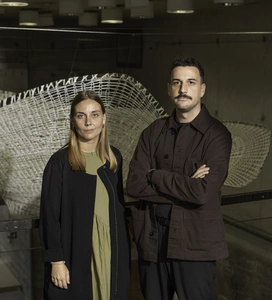
LAURA SOLSONA & EDUARD FERNANDEZ
Date: May 25, 2023
Goal: to build a collective Visual Essay on Eindhoven’s Infrastructures of Resistance in the form of a publication. The presentation of the work will take place in a performative manner, simulating a book launch.
self-office is a small practice that operates between architecture, landscape, and academia. Driven by specific themes and passing fascinations, the office aims to challenge disciplinary conventions to explore alternative realities beyond those driven by the market. Thus, we use space, objects, words, and images as research tools to produce architectural discourse. The office was founded in 2021 by Laura Solsona and Eduard Fernàndez.
The workshop consisted of:
1. An introduction of the self-office and a presentation of the project ‘Infrastructures of Resistance’ followed by a brief exploration of the students work and lecturers to explore new ways of living together
2. A presentation of the activity to the students: exploring the possible “Infrastructures of Resistance” in Eindhoven’s city centre and then collectively work together to create a publication that will build a collective imaginary revealing different acts of resistance of humans and non-humans of Eindhoven.
3. Students explored their areas of choice in groups of approximately 5 students, taking pictures of the area
4. With a template, provided by Laura and Eduard, the students inserted their pictures together with a sentence or definition, forming a chapter of the book each. The result is a visual essay of Eindhoven’s Infrastructures of Resistance.
5. Organising a book launch, presenting all the different chapters as editors of the publication. The book was printed for publication and distribution.