Disorder Manual
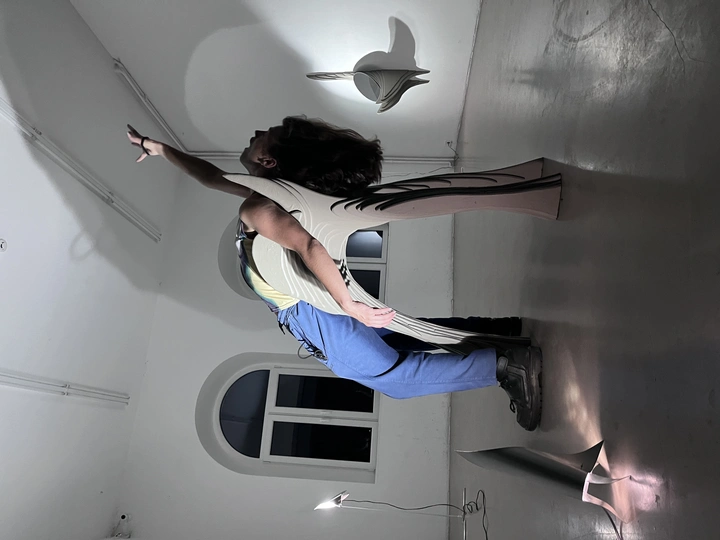
I'm originally trained as an architect, and during the last 7 years my practice shifted a lot to more transgressive fields like contemporary art, research based projects.
In 2022 I've curated "Politics of Space" symposium at SODAS 2123 in Vilnius, during 2022-2023 I was curator of Experiments' platform at Architektūros fondas.
Recently, I'm alumni of Ruperts' Alternative education program of 2024.
My interests spin around aesthetics of neglect, forensic architecture, intangible sustainabilities, and spatial crip theories applied to the space. In my artistic/research practice I often use different medias to interfere with architecture: sound, performance, object design, text and vocals.
My daily practice is designing exhibition architecture for various exhibition projects across Lithuania and Baltics. Currently I work as a chief architect for Contemporary Art Center in Vilnius.
This is about working with spaces that resist intended function. Interiors marked by trauma, voids shaped by neglect, architectures that no longer accommodate. Rather than repair, I stay with the misalignments.
Disorder Manual is an ongoing spatial practice that approaches dysfunction, misalignment, and spatial “failure” as aesthetic and conceptual material. Drawing from crip theory, forensic architecture, and critical design, I treat space as a body: vulnerable, reactive, political.
Through small insertions — architectural prosthetics, subtle distortions, sound or narrative interventions — I test how damaged or deviant spaces might adapt without erasure. These gestures do not aim for resolution. They are methods of coexisting with instability, of inhabiting asymmetry.
Much of this work takes place in domestic and transitional interiors, gallery infrastructures, or temporary communal architectures. These sites — already tense, already disobedient — offer a live surface for spatial negotiation.
Disorder Manual seeks to continue this development in new contexts, in dialogue with others who treat design not as solution, but as attention. As proximity. As friction.