Embedded Temporal Localities
Nuri Seçkin is an architect working across architecture and urban design, with a focus on ecological resilience, collective spatial practices, and critical territorial thinking. He holds a Master's degree in Sustainable Urban Planning and Design from KTH Royal Institute of Technology, where his project Embedded Temporal Localities explored new modes of inhabiting uncertainty in the aftermath of volcanic disruptions in Grindavík, Iceland. Nuri’s work often moves between speculative design, ecological precarity, and collective authorship. As part of this ongoing inquiry, his earlier project Clog: The Architecture of Residual Drains was exhibited at the 2025 Venice Architecture Biennale in the Turkish Pavilion, selected through an open call. Although distinct from Embedded Temporal Localities, Clog shared a similar ethos by exploring speculative, situated, and regenerative architectures that invite collaboration with natural and social systems. He is currently based in Stockholm.
What happens when the ground beneath us moves, not just physically, but existentially? When permanence fractures, and a place once inhabited becomes terrain of uncertainty? In the aftermath of the 2023 volcanic disruptions in Grindavík, Iceland, this project embraces uncertainty as a condition of design. Rather than restoring what was lost, it proposes new forms of inhabitation shaped by temporality, ecology, and collective agency.
Working across territorial, infrastructural, and local scales, the proposal introduces temporal protagonists: spatial actors tied to different durations, from days to weeks, months, or even years. These protagonists sustain presence in absence. They hold space when people cannot and gradually return it when conditions allow. Each intervention responds to a temporal rhythm, yet together they preserve the possibility of locality.
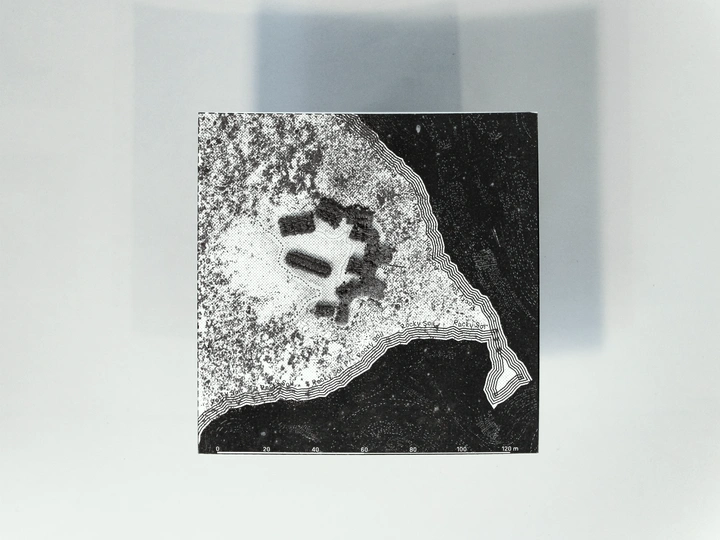
At the territorial scale, the project draws from Icelandic turf-building traditions, not as nostalgic form, but as method. Clusters of sacrificial, turf-informed structures are placed across the lava field. Designed to burn, erode, or be reclaimed by soil, they preserve ecological imprints for future flora and fauna. These dispersed architectures form a network for gathering, research, and ritual that reweaves the lava landscape into shared experience.
The infrastructural scale speculates on geothermal systems embedded in volcanic rock. Elevated pipelines and modular platforms span the terrain, enabling movement, energy transfer, and research access. These light interventions reveal the fragility of the surface while allowing new encounters with deep time.
Locally, protective berms are reimagined as four spatial typologies: inhabited, embedded, untouched, and speculative. Some hold communal programs, others are hollowed into introspective chambers, one is left to regenerate, and one anticipates future burial. Together, they confront solastalgia and reconnect the territory with urban life.