Toolbox against retail vacancy
Inès Lisser is a French architect-artist living in Vienna and trained between Paris and Berlin. She designs field studies, exhibitions, tours and workshops to raise awareness on urgent urban issues. Her spatial practice starts on the ground, building missing bridges between stakeholders and local communities.
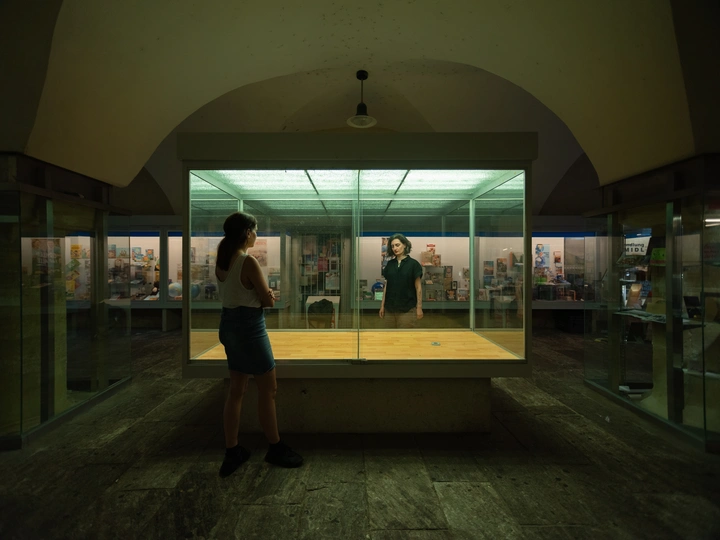
- As artist, she conducts field studies around retail vacancy in the frame of residencies (AIR Lower Austria in 2023, ZK/U in Berlin upcoming in 2026). Following the residency in Lower Austria she curated her first solo-exhibition at the ORTE gallery with interactive displays to collect visitors’s voices. The exhibition generated many discussions within the municipality of Krems and was featured in local and international medias such as ORF Radio, DETAIL Magazine, Architektur Aktuell, World Architects.
- As independant researcher, she gathers and studies best practices on non-commercial space reactivations throughout Europe. She intervened as guest critique in workshops and project juries at the FH Potsdam (DE) and at the NJIT (US) and exchanges knowledge with TU Wien researchers.
- As cultural mediator, she now designs and leads workshops for children at the Creative Cluster in Vienna merging architectural concepts and creative improvisations (dance, theater, drawing). She also elaborates collaborative tours around vacant spaces to generate debates and perspectives in public space. She also worked several years for the Pavillon de l’Arsenal and the Forum du Grand Paris leading tours on a wide range of architectural-related topics for all kinds of publics (general public, institutions, politicians, children, experts).
- As junior architect and urban planner she gained experience in international architecture and urban planning offices on public commands, competitions and European tender management (Baumschlager Eberle, AJN, Holzer Kobler, Cobe).
Toolbox against retail vacancy is an ongoing experimental project weaving missing connexions between empty spaces and communities’ needs. Whereas the architectural command comes years after land use decisions and urban strategies, this project gives to architects an anticipation role. Navigating between theory and practice, the project dives into public policies, local stories, academic frames and artistic production to open up the black box of vacancy.
The toolbox is a set of collaborative formats designed to demystify the vacancy issue and detangle its complexity for all kinds of publics through exhibitions, tours, cartographies, records, games…the aim is to facilitate a dialogue between local decision-makers and residents.
The project started in 2023 during a residency at AIR Lower Austria. I came with the idealistic idea of opening a vacant shop to the public. Then I faced the reality behind what felt like a simple gesture: the highly political topic, the indifference of shop owners, the shame and the helpless feeling surrounding the issue.
And the will to erase vacancy from both public space, urban studies and discourses. I understood that I had to shift my methodology towards a practice of immersion and radical listening. After hours of empirical field study and separate meetings with political, cultural and associative actors, I felt the responsability to build bridges between stakeholders and residents.Through a collaborative tour and my exhibition “Leerstand”, I set a common ground of knowledge and acted as facilitator to open the debate.
How to design sustainable interfaces between public and private spaces? How to secure land use for communities in the long term? How to regulate the surrender of spaces? When commercial spaces fail, how to defend tailor-made uses for local communities? Within an Atlas of best practices with examples of towns and villages overcoming the issue, I’m now looking for frames to conduct reports in different european contexts.