Artifacting a Dutch Flooded Archaeo-Landscape
Roberta Di Cosmo
Queenie Lin
Ana Robles Pérez
Ana Robles Pérez and Roberta Di Cosmo are researchers and social designers whose collaborative practice explores collective memory, territorial belonging, and activist climate narratives. Meeting during their Master’s in Social Design at Design Academy Eindhoven, they developed a shared approach that blends critical, community-based, and site-specific design methods. Their work sits at the intersection of visual design, spatial-landscape practices, and documentary-driven social engagement.
Using hybrid methodologies spanning forensic, anthropological, journalistic, and performative tools, they analyze territories through what they call a “micro-lens”: small, often overlooked gestures or familiar details that open broader, systemic reflections, or “macro-lens” insights. Their projects unfold through participatory interventions, immersive installations, visual publications, workshops, and documentary artifacts.
Rooted in everyday narratives and invisible cultural layers, their work challenges dominant discourses by amplifying marginalized voices and fostering local engagement. Education is central to their practice, emphasizing both outcomes and the creation of adaptable tools and processes for socially and ecologically grounded design.
Together, Ana and Roberta are building a body of work that bridges research, activism, and territorial practice, offering new ways of relating to place, memory, and community. Both are active in education at the Royal Academy of Art (KABK) and Design Academy Eindhoven (DAE), and their projects often involve collaborations with institutions such as TBA21 – Thyssen-Bornemisza Art Contemporary, Waterschool – Studio Makkink and Bey, ARQVA – The Spanish Museum of Underwater Archeology, The Watersnoodmuseum, and Het Nieuwe Instituut in Rotterdam.
“If you see me, weep.” This haunting inscription on the Hunger Stone of Děčín—once submerged, now exposed by drought—embodies a powerful intersection of historical warning, geological record, and human imagination. Engraved during past climate crises, these stones served as hydrological markers and moral messages to future generations, transforming environmental observation into public memory.
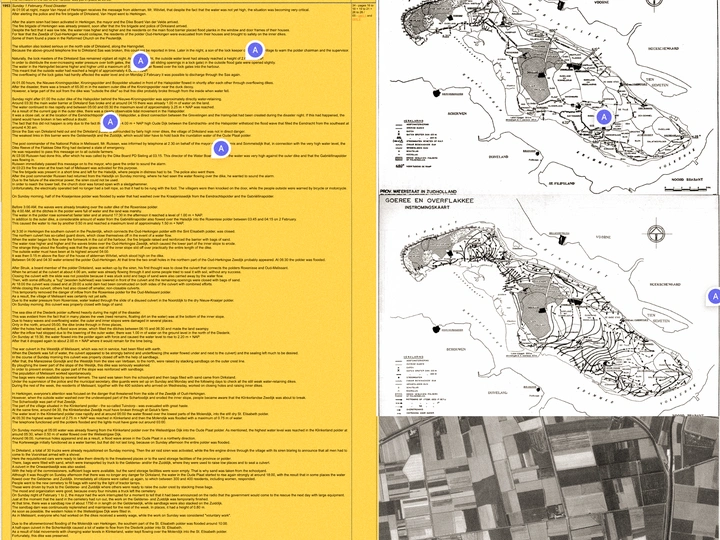
Inverting this historical gesture, "Artifacting a Dutch Flooded Archaeo-Landscape" explores how design can respond to flooding, not as sudden catastrophe but as an inevitable, slow event with archaeological and symbolic consequence. By connecting intertemporal knowledge through the 1953 North Sea Flood and the Dutch territories projected to be submerged by 2050, the project offers speculative, forward-looking design interventions that rethink and broaden archaeological approaches. It asks: how can artifacts of the future be intentionally designed, communicating urgency, resilience, and care across generations? By merging speculative archaeology, environmental storytelling, and visual design, the project reimagines submerged landscapes not as lost, but as latent archives of meaning. It proposes tangible strategies for encoding collective memory into threatened geographies, turning water from a force of erasure into a medium of remembrance.