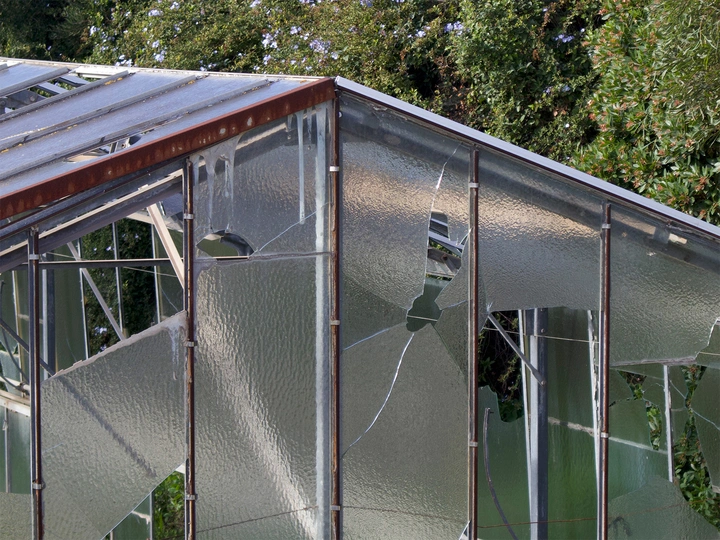
Derelict greenhouse of Carqueiranne
Héloïse Floc'h
We are Co-Formations, a collaborative design duo of Héloïse Floc'h and Theo Colin. We work across scales and disciplines with a focus on context-specific projects. We met at the Design Academy Eindhoven 4 years ago and have since worked in collaboration with a methodology we have developed. I (Héloïse) bring a sensitive eye to designing for people and places. My approach is always human-centred, and I strongly believe in the importance of social design. My skills are in researching, curating and communicating our ideas in ways that can be understood across backgrounds. Theo is a great problem solver and maker; he has a strong imagination for possibilities. He is also very comfortable in workshops and in building objects, which allows us to test our ideas and work on a 1:1 scale.
We then pursued an MA at Studio for Immediate Spaces at Sandberg Instituut. The two years were used as a testing ground to strengthen our methodologies and modes of collaboration. We have built numerous projects in public space, such as an outdoor kitchen for Kaskantine (a community-run garden in Amsterdam), an arts festival seating scenography in collaboration with a friend, Jules Coumans, for Kakamama in Maastricht, a mobile cooking station for the Studio for Immediate Spaces and a mobile kiosk to promote and gather participants for Staging Cancer, a project that looks at the importance of culture and arts in cancer treatment at VUmc Amsterdam.
Alongside the physicality of our practice, we are also deeply rooted in research; we have made publications on subjects such as; the material of memory in the context of dementia, the digital afterlife and future of mourning, and the rise and fall of the floriculture industry in the south of France. Outside of our duo, we are deeply collaborative designers; we are excited and energised by the ideas of others, and we see our role not to be the master planners but as organisers, initiators and facilitators of positive change.
This site-specific project is located in Carqueiranne, a Southern French town which sits between Hyères and Toulon. The region was once home to a booming floricultural industry. They were world-renowned for their greenhouse climate control techniques and growing recipes. The flower that made them famous was named the ‘Giant Tulip of Carqueiranne’, a tall, elegant flower that grew up to 1,30 metre.
Throughout the 60s and 70s, this region’s growth was fueled by the expansion of global trade, allowing producers to sell flowers all over Europe and North America. However, by the 1980s, the same open doors that built Carqueiranne’s floricultural industry welcomed larger-scale intensive farms that oversaturated the markets, pushed down prices, and eventually drove many local growers out of business.
Today, all that remains of this history are the architectural remnants. In 2022, the Agriculture Chamber of the Var’s study found that there are still over 106 hectares of abandoned glass greenhouses in the region. We are focused on one greenhouse in particular, which we chose due to its proximity to the centre of Carqueiranne and to the area from which half my family is from. The first steps of our methodology were to interview growers, passersby and nearby archives. Here, we learned of the heritage of the region and of the want and need for more social community spaces.
Following this, we engaged in talks with the municipality, which knew the plot well but was unsure of its future development. It was clear to us that a different approach was needed to shift the perspective of a site that had long been overlooked.
Next, we developed what we call ‘Conversation Objects’. We have created outdoor street lamps made up of the shards of broken glass found on site. Through showing these objects as examples, we hope in the future to organise workshops to explore how we can collaboratively alter, rebuild, and mend this abandoned space.