Dealing with Uncertainity.
Elisabeth Terrisse de Botton (Barcelona*1991) graduated with honors in 2017 from Escola Tècnica Superior d’Arquitectura de Barcelona (ES).
Since 2015, she has collaborated in different architecture practices in Barcelona (ES), Lausanne (CH), and Brussels (BE), such as Arquitectura-G, Traumnovelle, Chevalier Masson, and Baukunst. She participated in several design reviews as a guest critic for first and second-year architecture studios at EPFL (CH) and LaCambre (BE).
Matthieu Brasebin (Paris*1996) graduated with his master’s degree in 2020 from École Polytechnique Fédérale de Lausanne (CH) after his bachelor’s studies in Paris-Malaquais (FR) and an exchange year at Université de Montréal (CA). Since 2018, he has collaborated in several architecture offices in Montréal (CA), Lausanne (CH), Copenhagen (DK), and Brussels (BE), such as BIG, noAarchitecten, and Atelier Kanal.
Since beginning their collaboration in 2023, following their winning proposal for Europan17, they have engaged in a variety of experimental formats and collective practices. Their work includes ephemeral architectural installations presented at international platforms such as Concéntrico, the Tallinn Architecture Biennale, and Horst Arts & Music Festival, and essays soon to be published for Practices in Research.
We began exploring the challenges of uncertain material flows through our recent project "No Time to Waste", an experimental pavilion developed for the Tallinn Architecture Biennale 2024 under the theme "Resources for a Future". The pavilion, a prototype for a 45-meter-long urban canopy envisioned for Tallinn’s Balti Jaam bus stops, interrogates the intersection of public space and material circularity.
Responding to a brief that required working entirely with unknown, locally sourced, reused materials, we could not propose a complete design from the outset. Instead, we developed an adaptable framework of spatial actions: filling (with waste), assembling (beams and structural systems), and cladding (with found roofing material). These processes became the drivers of design, not the specific materials themselves.
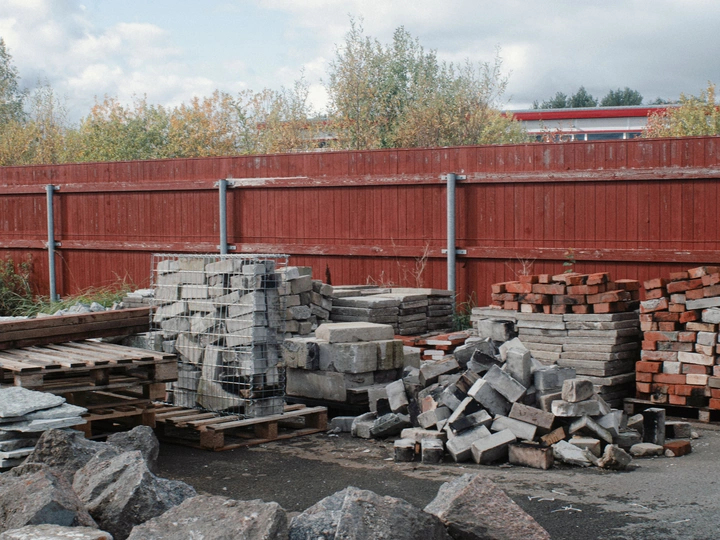
The pavilion was constructed using only reclaimed materials sourced from demolition sites, waste collection points, and other urban material flows. We worked with all elements “as found”, accepting their imperfections and prior histories. Some retained their former architectural role, while others, previously classified as waste, were reinterpreted through careful curation. The result questions the logic of modern standardization and celebrates bespoke methods executed entirely by non-professionals.
This project opens a wider inquiry: how can we design and build without knowing what resources will be available? We are interested in developing this into a broader research and workshop-based framework, working with students, architects, engineers, and designers to experiment with uncertain material contexts. Through prototyping, case study research, and collective exploration, we aim to build a catalog of spatial actions and design attitudes grounded in reuse and improvisation.