

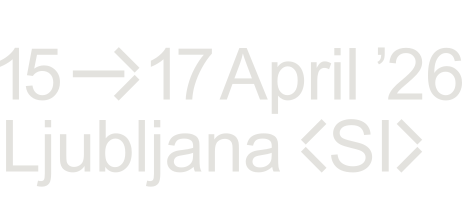
Ljubljana, Slovenia
Faculty of Architecture of the University of Ljubljana, Zoisova cesta 12
Museum of Architecture and Design, Rusjanov trg 7
About
LINA Blueprints are a three-day live platform showcasing concrete ideas, methods and practices developed within the European architectural platform. The events and discussions will focus on processes, collaborations and modes of operation that address common architectural challenges, from living spaces and communities to materials and ecology.
Through a variety of activities, including lectures, talks, workshops, walks and film screenings, LINA Fellows and Members will present their vision of architecture as a collaborative process that emerges among people, in space and over time.
For its inaugural edition, LINA Blueprints will create an overview of the first three years of operations, which featured 322 collaborations with 110 LINA Fellows. The programme was co-developed with Federica Zambeletti, who was given the task to synthesise the varied modes of collaborations and their outcomes into digestible nuggets of insight. These can serve as blueprints for anyone looking to use spatial practices to create communities themselves.
LINA Blueprints: (un)common practice approaches collaboration as communing, a way of working, learning, and inhabiting space together. Rooted in the LINA community, the festival understands the platform as a living collective that gathers, exchanges, and produces knowledge in common. Communing unfolds through cooking, walking, writing, building, and conversing. These acts become spatial practices through which the community rehearses forms of togetherness that are situated, bioregional, and collective. Architecture shifts from object making toward relationship making between people, territories, and institutions. The “un” in uncommon acknowledges that community is never seamless. It holds friction, difference, and negotiation. Rather than presenting finished answers, the festival foregrounds process and shared responsibility as the ground for future spatial practice.
Featuring
LINA Fellows
Space Saloon (Rebecca Looringh-van Beeck, Gian Maria Socci)
Lemonot (Sabrina Morreale)
Bernadette Krejs
Tina Marie Asoh (Planting Solidarity)
Ajda Bračič
Rebeka Bratož Gornik
Spolka (Viktória Mravčáková)
Continentale (Giulio Galasso)
Prostorož (Zala Velkavrh)
Featuring work by:
Jade Apack, Charly Blödel, Estelle Jullian, Hannah Segerkrantz, Benedetta Pompili, Adam Przywara, Irena Übler, Andrea Arcese and Loris L. Perillo, Nabi Agzamov, Eleni Axioti, Rajna Avramova, Ajda Bračič, Francesca Beltrame, Đorđe Bulajić, Róisín Cahill, Aušra Česnauskytė and Goda Verikaitė (Neo-futuristic Walks), Patrícia Coelho, Francesca Cocchiara and Sergios Strigklogiannis, Tom Cookson, Myrto Delimichali, Ewa Effiom, Lýdia Grešáková and Viktória Mravčáková (Spolka), Melissa Harrison, Emily Jones and Nicolas Howden (Rubble), Lilla Kammermann and Lilla Luca Varga (girlscanscan), Tatuli Japoshvili and Giga Tsikarishvili (Wit[h]nessing), Kateřina Krupičková and Martin Zwahlen (zwickr studio), Ena Kukić and Dinko Jelečević (E+D), Elspeth Lee (Superposition), Lucille Léger and Jacques-Marie Ligot, Hedwig van der Linden and Kevin Vesterveld (Dérive), Tevi Allan Mensah, Helen McFadden, Diāna Mikāne and Paula Veidenbauma (gel office), Ralph Nabil Nasrallah, Alberto Roncelli, Liisa Ryynänen, Laura Solsona and Eduard Fernàndez (self-office), Jonathan Steiger, Dimitri Szuter, Francesca Vanelli, Juri Velt, Natalia Voroshilova and Giulio Galasso (Continentale), Margarida Waco, Kuidas.works, Anna Perugini, Studio ACTE, Jakob Travnik, Willie Vogel & Eileen Stornebrink (Studio Inscape), Sonder, Meriem Chabani (New South), Rocio Calzado and Jasper Meurer (docar), Joaquin Mora, Rebeka Bratož Gornik
LINA Blueprints Curator
Federica Zambeletti is an architect working at the intersection of art, architecture, and critical theory. She is the founder and managing director of KoozArch, a studio and magazine dedicated to exploring architecture as a cultural, political, and ecological practice beyond its built form. Conceived as an open and inclusive platform for research, experimentation, and dialogue, KoozArch foregrounds architecture’s capacity to engage with urgent planetary, social, and cultural questions. Through editorial projects, conversations, and collaborations, it expands spatial discourse and advances alternative modes of practice and knowledge production. Her previous cultural initiatives include the transformation of an 18th-century palazzo into a foundation for Anish Kapoor, exhibition designs for LAS Art Foundation and the Willem de Kooning Foundation, and the research project Antarctic Resolution. The latter culminated in a 1,000-page publication with Lars Müller Publishers and a series of international exhibitions, including presentations at the Venice Biennale and the Thyssen-Bornemisza Museum in Madrid.
Schedule
15 April 2026 / Faculty of Architecture of the University of Ljubljana
| Time | Activity |
|---|---|
17.00 |
Welcome addresses |
17.30 |
Federica Zambeletti (KoozArch) |
19.00 |
Alexandra Trofin (Beta - the Timișoara Architecture Biennale)Lenses of Care: Long-Term Impact of the Temporal |
16 April 2026 / Museum of Architecture and Design
| Time | Activity |
|---|---|
| 9.30–13.00 | From Space to Place: Situated Making Practices Part Iworkshop Rrrubble: Prototyping an Archive: Space Saloon & The Maak A hands-on workshop that questions the way we see, represent and think of discarded objects and material memory. Guided by Marxist terminology, participants will engage in a collective, hands-on analysis of items found in the basement of Ljubljana’s Museum of Architecture and Design. Through a series of playful, action-based drawing prompts, we will attempt to capture their unique, often inexpressible essence. Moving between intellectual analysis and intuitive mark making, the workshop invites participants to rethink architectural representation to embrace a deeper intertwining with things. Open to all experience levels, this is an invitation to learn by doing, build community, and discover new narratives from what already surrounds us. |
| 9.30 | Materials & LibrariesExhibition preview Tina Gregorič Dekleva (TU Vienna), Tina Marie Asoh (Planting Solidarity) The exhibition Materials and libraries shifts the focus of architecture from the incessant production into a prosition of a praxis that wishes to transform all elements of an architect’s profession. Starting from how we think and write about spatial practices to what we build with and why. The reflections of LINA Fellows active in the past three years offer a different, sustainable reality. They are aiming for a more just society, a more responsible handling of the limited resources of our planet and an architecture rooted in care. |
| 10.00 | Against the Object: A Library for Architecture After AuthorshipSabrina Morreale & Lorenzo Perri (Lemonot) in conversation with Blaithin Quinn (Irish Architecture Foundation) Against the Object: A Library for Architecture After Authorship questions architecture as a self-contained artifact and repositions it as a cultural and collective medium. It explores how buildings are shaped not only by design, but by how they are inhabited, interpreted, and transformed over time. Rather than celebrating authorship, the talk proposes an architecture grounded in use, ecology, and shared agency. |
| 11.00 | Beyond the Normative Voice: Inclusive Writing PracticesAjda Bračič (Kajža), Tina Marie Asoh (Planting Solidarity), and Bernadette Krejs in conversation with César Reyes Najéra (dpr-barcelona) Beyond the Normative Voice: Inclusive Writing Practices interrogates who gets to speak in architectural discourse and how language can unsettle its inherited hierarchies. It approaches writing as a spatial practice, one that can host dissensus, partial perspectives, and situated knowledge rather than a single authoritative tone. The talk proposes forms of editing, publishing, and storytelling that redistribute authorship and open the field to voices traditionally kept at its margins. |
| 11.00–13.00 | Taste of Place: Slow Cooking, Shared TimeStanka Duša (UL FA), Hana Cirman (LINA) workshop An exercise in communal care with traditional Slovenian food. |
| 12.00 | Periple Duet: Words and JourneysJohn Bingham-Hall (Theatrum Mundi) in conversation with Manuel Henriques (Lisbon Architecture Triennale) Periple Duet: Words and Journeys proposes observation, movement, and duration as fundamental tools for architectural inquiry. Through travel undertaken over time, the Periple becomes a methodology, one that values slowness, attentiveness, and embodied experience as forms of research. The talk reflects on how knowledge emerges in transit, shaped by shifting landscapes, encounters, and the temporal depth of the journey itself. |
| 13.00 | Lunch break |
| 14.00 | Is Nature Modern?Guided tour Maja Vardjan (Museum of Architecture and Design - MAO), introduction by Line Ramstad (Oslo Architecture Triennale) on the topic of What if Nature Comes First? |
| 14.00 | Against the Canon: Counter-Learning PracticesRebecca Looringh-van Beeck (Space Saloon), Freo Majer, Moritz Maria Karl in conversation with Bernadette Krejs Against the Canon: Counter-Learning Practices questions the authority of architectural canons by treating them not as fixed inheritances, but as constructs open to interruption and refusal. It explores how spatial and pedagogical practices can unsettle dominant narratives, disrupt habitual ways of seeing, and expose whose histories and values are legitimised. The talk proposes counter-learning as a collective, embodied process of unlearning and re-claiming knowledge to imagine more diverse, situated, and transformative futures for architecture. |
| 15.00 | Is Nature Modern?Guided tour Maja Vardjan (Museum of Architecture and Design - MAO), introduction by Line Ramstad (Oslo Architecture Triennale) on the topic of What if Nature Comes First? |
| 15.00 | Architecture in Motion: Film as MediumSabrina Morreale & Lorenzo Perri (Lemonot), Josephine Michau (Copenhagen Architecture Forum) and Pippo Ciorra (MAXXI), in conversation with Rebeka Bratož Gornik Architecture in Motion: Film as Medium explores videomaking as a critical tool for investigating architecture beyond static representation. Through the moving image, space is approached as temporal, political, and inhabited—revealing processes of transformation, displacement, and cultural production often invisible in drawings or photographs. The talk reflects on film as both method and medium: a way to question how architecture frames movement, and how movement, in turn, exposes the social and economic forces shaping the built environment. |
| 16.00–18.00 | Film screeningsPlayscapes by New South The Great Together by docar (MAXXI & LIFT) Sound That Remains by Joaquin Mora (DAI-SAI) To Our Windows by Tevi Allan Mensah (MAXXI) Stroll the Ring Road by Jonathan Steiger (Theatrum Mundi) State of Preparedness by Rebeka Bratož Gornik (Barleti University) The Ground for Culture by Rebeka Bratož Gornik (MAXXI) Dom Penzionera: Space of Becoming by Rebeka Bratož Gornik (LIFT) |
| 17.00 | Snack break |
| 18.00 | Dialogue as Practice: Learning in the City Part ILecture Viktória Mravčáková (Spolka) |
| 18.30 | Dialogue as Practice: Learning in the City Part IILecture Giulio Galasso (Continentale) |
| 19.00 | Housing at Risk: A Community ConversationViktória Mravčáková (Spolka), Giulio Galasso (Continentale), Elina Polianska (METALAB), in conversation with Karen Jagodin (Estonian Museum of Architecture) Housing at Risk: A Community Conversation brings into dialogue two conditions shaping modern housing today: the long-term transformation of post-war estates and their collective ambitions, and the immediate pressures of displacement, scarcity, and crisis. By placing critical research alongside situated practices of repair, reuse, and resident-led action, the discussion exposes the gap between inherited housing models and present realities. Within this tension, housing emerges not as a stable form, but as a contested and adaptive resource—continuously reconfigured to sustain collective life under changing conditions. |
| 20.00–24.00 | Courtyard party with DJ Tina Marie Asoh (Planting Solidarity) |
17 April 2026 / Museum of Architecture and Design
| Time | Activity |
|---|---|
11.00–13.00 |
From Space to Place: Situated Making Practices Part Iworkshop Rrrubble: Prototyping an Archive: Space Saloon & The Maak A hands-on workshop that questions the way we see, represent and think of discarded objects and material memory. Part II presents the outcomes and methodology. |
11.00 |
Care as Method: Adaptive Reuse in PracticeAjda Bračič (Kajža) in conversation with Alexandra Trofin (Beta - Timișoara Architecture Biennial) Care as Method: Adaptive Reuse in Practice understands renovation not as a technical upgrade, but as a social act embedded in existing relationships and everyday life. It considers how working with what is already there—materials, memories, and communities—can become a practice of attentiveness rather than replacement. The talk frames care as an operative stance: incremental, negotiated, and collective, reshaping buildings through dialogue, stewardship, and long-term responsibility. |
12.00 |
Participation as a Method: Collective MethodologiesGian Maria Socci (Space Saloon) and Zala Velkavrh (Prostorož) in conversation with Elena Falomo (Bolwerk - Living Summer School) Participation as a Method: Collective Methodologies approaches architecture as a process shaped through shared authorship and situated collaboration. It examines hands-on, site-based practices where tools, conversations, and temporary structures become devices for negotiating space collectively. The talk frames participation as an operative framework—structuring how projects are initiated, tested, and transformed through ongoing exchange rather than predetermined outcomes. |
13.00–15.00 |
Lunch break |
15.00–16.30 |
On Accessibility - Fužine Neighborhoodwalkshop Ajda Bračič (Kajža) & Miloš Kosec (Faculty of Architecture, University of Ljubljana) Engages the neighborhood of Fužine as a living archive, read step by step through its housing blocks, open spaces, and everyday routes. Moving together through Fužine, observation becomes collective, attentive to spatial patterns, informal uses, and the social life embedded in its modernist fabric. The walk frames movement as research: a situated, shared method for understanding how architecture is inhabited, adapted, and negotiated over time. |
15.00 |
Foraging as a Tool: Regrounding Exhibition Design Practicesguided tour Manca Košir and Jan Kozinc, authors of the exhibition design Foraging as a Tool: Regrounding Exhibition Design Practices reflects on how exhibition making can be rooted in attentive reuse, drawing meaning from existing materials, histories, and ecological questions. The talk positions foraging as a methodological stance: a way to rethink exhibition design as an exploratory, resourceful, and context-sensitive practice that makes visible new narratives. |
16.00 |
Time as a Method: Temporary and Enduring FormatsSaimir Kristo (Architecture Fund in Albania), Christian Burkhard (Architectuul), Barbora Špičáková (VI PER Gallery) in conversation with Sabrina Morreale (Lemonot) Time as a Method: Temporary and Enduring Formats treats projects as sequences rather than objects, structured through phases, editions, and evolving spatial scripts. |
17.00 |
Snack break |
18.00 |
So Heavy!lecture Carles Oliver see synopsis below |
19.00 |
Materials & LibrariesExhibition opening Tina Gregorič Dekleva & Thomas Amman (TU Vienna), César Reyes Najéra (dpr-barcelona) The exhibition Materials and libraries shifts the focus of architecture from the incessant production into a prosition of a praxis that wishes to transform all elements of an architect’s profession. Starting from how we think and write about spatial practices to what we build with and why. The reflections of LINA Fellows active in the past three years offer a different, sustainable reality. They are aiming for a more just society, a more responsible handling of the limited resources of our planet and an architecture rooted in care. The exhibition is open from 16 April to 31 May 2026. |
20.00 |
Evening gathering |
Accompanying programme
The Faculty of Architecture of the University of Ljubljana is participating in the festival with its spring programme of guest lectures, titled Europe 26. The latter connects internationally established architects and younger practices that focus on the topics of public architecture and housing, heritage, reuse and new materialities through the lens of ecology. Architecture stemming from the local context – knowledge, traditions, skills, and environment – is front and centre.
- 1.4. Carles Enrich, Carles Enrich Studio
- 9.4. Jonas Janke, Roberta Jurčić, b+ Prototypen GmbH
- 17.4. Carles Gabriel Oliver Barceló
- 21.4. Marta Peris in José Toral, Peris+Toral Arquitectes
Lectures
Alexandra Trofin: Lenses of Care: Long-Term Impact of the Temporal
Alexandra Trofin is an architect working at the intersection of design, cultural production and public administration. She is an advisor to the Mayor of Timișoara and the director of the Beta Architecture Biennial—an international platform that connects education, the city, and the architectural profession through dialogue and experimentation.
Her work explores architecture’s role as both a professional discipline and a cultural practice capable of shaping more inclusive and meaningful urban environments. She has contributed to projects ranging from urban design and curatorial initiatives to architectural competitions, across local and international contexts.
Educated in Timișoara and shaped by experience in both Romanian and international offices, Alexandra has also contributed to architectural education as a teaching assistant, before founding her own practice, Atelier Spațial. She is Vice President of the Timiș Branch of the Romanian Order of Architects, where she is actively involved in strategic development and public-facing programs.
About Beta
Beta - the Timișoara Architecture Biennale is a cultural project of the Timis Territorial Branch of the Order of Romanian Architects, celebrating 12 years of activity.
Beta is the main architectural event in western Romania, with a Euroregional influence, having a collaboration component at the level of the neighboring countries – Serbia and Hungary. An important part of the international connections is provided by Beta's membership of the LINA community
Beta articulates a series of actions, projects, events and exhibitions around 3 pillars: Education, Profession and City. What we propose is an architecture of action, defined by the desire to be proactive, to collaborate, to enter into dialogue and to relate. To finally understand the complete and complex map of the built environment. We want to promote interaction between different entities, before talking about concrete interventions. We propose dialogue instead of statements, collaboration instead of isolation, and processes instead of one-off events.
Carles Oliver: So heavy!
Global CO2 emissions have risen from 5 gigatonnes (Gt) to 37 Gt per year over the past century, of which the construction sector is responsible for approximately 37%. The Earth and the oceans can absorb only 19 Gt of CO2 annually, which corresponds to the available global carbon budget. And we spend twice we have.
The EU’s binding climate neutrality target for 2050 requires emissions to be reduced by 55% by 2030 and by 92% by 2050. If the carbon budget were to limit the number of dwellings we can build – as the financial budget has done until now –, what needs to be done to reduce these values in architectural design?
In the Balearic Islands, an example has been developed collectively, consisting of configuring habitability based on the 'map of local resources', which includes many factors such as social (knowledge & buildings traditions, typologies, skills, available labor, etc.), atmospheric (sun, rain, wind, etc.), or the local low-carbon materials that constitute the vernacular architecture, the cultural heritage, and the landscape of each territory, like stone or earth. In addition to materials derived from the optimisation of industrial processes, such as urban mining.
Not only have simple compression structures proved to offer greater durability and minimal embodied CO₂ emissions, they also provide the necessary inertia and mass to withstand extreme heatwaves, particularly in Mediterranean climates.
Exhibition: Materials and Libraries
The exhibition presents the work of LINA Fellows, who are shifting the focus of architecture away from the constant production of novelty towards a practice that strives for a more just society, for responsible stewardship of our planet’s limited resources, and for an architecture grounded in care.
Changes in our shared practice rely primarily on the self-initiative of individuals whose work demonstrates the kind of architecture they wish to create. The LINA Platform advocates for such alternatives to become commonplace and available to all.
Produced by
LINA Team
Matevž Čelik
Nuša Zupanc
Maja Bevc
Hana Cirman
LINA Blueprints visual identity
Anja Delbello in Aljaž Vesel (AA)
Materials and Libraries exhibition
Exhibition set design and realisation:
Maja Bevc & Nuša Zupanc Pavlič
Proofreading:
Vida Jocif, K&J Translations
Organisational support:
Blažka Kirm (MAO), Marie-Amélie Simechalle (Atelier LUMA), Thomas Amann (TU Vienna)
Production
Produced by the LINA platform,
coordinated by the Faculty of Architecture of the University of Ljubljana,
co-produced with the Museum of Architecture and Design,
co-funded by the European Union,
supported by Pro Helvetia and the Ministry of Culture of the Republic of Slovenia.