Understanding City Growth _ Atlas of Urban Mythologies
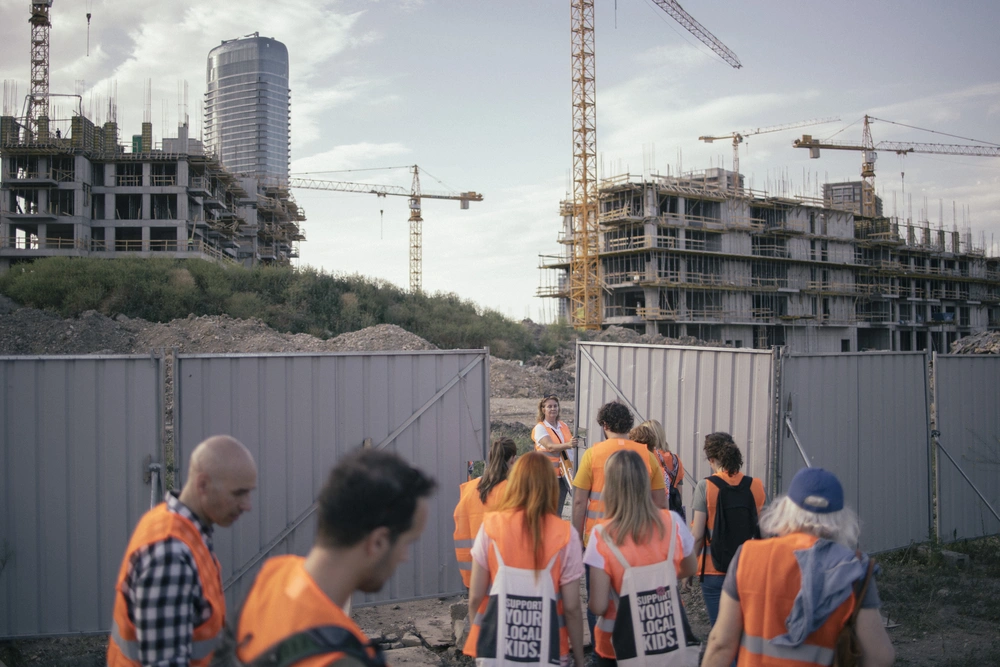
Many citizens of Belgrade have the impression that Belgrade is losing its identity and urban functionality. This is the result of accelerated city growth without a clear development strategy which cares about the city and its citizens.
We will try to find out how new generations of creative people coming from other contexts perceive the city of Belgrade and its future growth through a three-year programme that would focus on urban planning, architecture and ecology. Three editions of fortnight-long residency programmes per year will be organized in the first and the second years. BINA will invite creatives selected through the platform open call. Their task will be to respond to the topic through different forms and media of expression: design proposals, films, photographs or essays. Creatives will be paired with a local team/person that will be selected by an open call or invited by BINA. During their stay, BINA will organize presentations of creatives’ work in the most appropriate format and medium for each participant.
Atlas of Urban Mythologies/Chapter: Belgrade
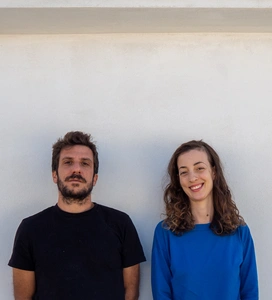
Francesca Cocchiara and Sergios Striglkogiannis (Italy/Greece)
As part of the 2022–23 LINA Architecture Programme, Francesca and Sergios stayed in Belgrade in February and May 2023. Research and work done in Belgrade are to be included in the project "Atlas of Urban Mythologies", a collection of urban narratives, which will consist of chapters dedicated to different cities: Athens, Nicosia, Tbilisi, Basel, Tirana, Ljubljana and Belgrade. As preparation for their stay, the BINA team provided texts about the city’s history, an overview of 20th century urban plans, as well as a series of texts that provide an insight into the current, post-2000’s situation defined by the property transformation of the housing stock, restitution and investor urbanism. During his stay in Belgrade in February 2023, Sergios Strigklogiannis closely collaborated with Ljiljana Radošević, art historian, expert and connoisseur of street art, and got acquainted with the topography and history of Belgrade. At the same time, he came into contact with the Ministry of Space collective (Jovana Timotijević, architect, PhD candidate at the Faculty of Political Sciences), whose focus is advocacy for democratic and fair development of the city: democratization of the management of public spatial resources, participatory planning and the right to housing. Upon his return to Athens, based on personal insight and conducted interviews, a series of documentary photographs and video material, Sergios and Francesca worked on the Belgrade chapter of the "Atlas of Urban Mythologies". In this chapter, in an extremely insightful and humorous way, through the form of a dramatic text, they talk about the neuralgic points of the city, gentrification, the disappearance of green areas, the status and affordability of the old (up to 1990s) and the new housing stock (post 2000s). And precisely by pointing out these phenomena, they touch on spatial discrimination as their immediate consequences, visible through the increasingly pronounced segregation of the population, rich - middle class - poor, which was not characteristic of Belgrade until 20 years ago.
On LINA DAY, May 13, Sergios and Francesca presented the Belgrade chapter. In addition to the participants of the LINA platform, some international BINA participants and a few foreign students, the audience at the presentation was predominantly made up of representatives of the local professional and general audience. The presentation followed by the discussion was extremely well evaluated, the problems were well located, the correlation between different historical and spatial narratives was successfully established. The completed chapter on Belgrade contains all the elements that the authors defined in the announcement of their project: the urban issues that will be analyzed and highlighted, references to support the theoretical framework of their research and a collection of skillfully chosen local stories that form the backbone of the plot. We would like to specially underline the literary style and the discreet but precise humor of this text, which contributes to making this text interesting to a wide audience, not only experts. We believe that the exceptional value of this project "Atlas of Urban Mythologies" is that it brings together a large number of LINA members (dpr-barcelona, S AM Swiss Architecture Museum, Barleti University, Tbilisi Architecture Biennale, Faculty of Architecture, Ljubljana and BINA) so the final edition will present the status, problems and challenges present in a number of European cities, and at the same time be an opportunity to make the work of Sergios Strigklogiannis and Francesca Cocchiara visible to a wide audience and be an impulse for their further work and career . The next step in the realization of this project is the finalization of all chapters, the preparation of online promotion and the release of the printed edition of "Atlas of Urban Mythologies" published by dpr-barcelona.
"…By the river, here’s where I found them. I was still on my boat, passing under the bridge, but I decided to drop anchor there at the Sava amphitheater once I saw them. They were immersed in their conversation, so I went unnoticed and pulled out my camera. One of them must have been a deity, her adorned hair and dress looked from ancient times, but her face was ageless. She sat on her throne the whole time, showing tiredness and resignation more than once. By her side stood a giant holding a tree in its hand. I was expecting it would smash it with its concrete jaws wide open, but somehow it didn’t. In front of the giant, an army of six sergeants settled down; they were all proudly coated in red suits, showing their side profiles and speaking synchronized. Next to them sat a massive, wet, inflated, yellow duck. It didn’t seem bothered by the large banner stuck under its belly, and I wondered what was written on it.”
- Excerpt from Atlas of Urban Mythologies by Sergios Strigklogiannis and Francesca Cocchiara