MODEL _ Panots Carpet
Three teams which included five LINA fellows were invited to participate in the activities of MODEL
Barcelona Festival of Architectures, organised and managed by Fundació Mies van der Rohe and in the context of the EUmies Awards programme.
The objective when choosing the three teams was to have complimentary points of view to the topic of the MODEL Festival: Radical Empathy which is also connected to the topic being discussed upon the results of the EUmies Awards 2022 and 2023: Education. On the one hand, we invited Palace of Unlearning to develop a project on narratives taking the Barcelona Pavilion as the point of departure. zwkr were invited to tackle with the ecologies in the area where the Pavilion is located, an important green area of the city still in need of improvements. The third guest participated in the event 10X10 manifestos to briefly reflect on complex topics with a dialectical encounter between locals and visitors where the guest was asked to speak about “courage”. This diversity of participants, complemented with Federica Sofia Zambeletti from a communication point of view, has allowed for an inclusive and broad discussion on the role of architecture and architectural culture. The outcomes have been the construction of two actions with a strong impact that have included workshops with the audience from the previous research developed for the occasion by the authors, talks and first steps towards the further development of the topics.
Collaboration with LINA Fellow zwkr
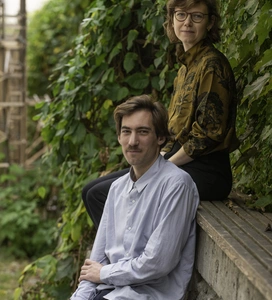
Panots Carpet was developed by two LINA fellows from “zwkr”, Kateřina Krupičková and Martin
Zwahlen. They first visited Barcelona in February 2023 and met the director of the Barcelona Landscape Biennial, Marina Cervera – with who they delivered a lecture at the Barcelona School of Architecture (ETSAB-UPC) – and the team of “Parcs i Jardins” (Parks and Gardens) of the Barcelona City Council.
Following an exploration of the area of Montjuïc, around the Barcelona Pavilion, they developed the
proposal. The "Panots Carpet" project was inspired by the historical context of the Pavilion's surroundings and used a mixture of natural materials that change over time, creating a pattern that blurs and expands. It reflects the spirit of innovation and experimentation that the Pavilion embodied. The traces of people crossing the square become visible. After the rain, certain materials darken more than others. Water is stored in them, and evaporation creates a natural cooling effect. The carpet is a place for everyone, allowing plants and insects to thrive in its joints and gaps. It is composed of various natural materials that are locally available and will decompose through time. An accompanying event was set up around the carpet, with parasols placed in the former locations of the trees to provide shade for people to gather and experience the original atmosphere with the interrupted view. The carpet was installed for the opening of the Festival on 20 April.
The intervention has been left in the public space to see how it evolves. The idea is that the seeds and materials will extend to the whole surface and transform it in the next months. Children
immediately saw the potential and started participating. Dogs and people have also continued being involved in it.