MODEL _ Palace of Un/Learning: Glitching Mies
Three teams which included five LINA fellows were invited to participate in the activities of MODEL
Barcelona Festival of Architectures, organised and managed by Fundació Mies van der Rohe and in the context of the EUmies Awards programme.
The objective when choosing the three teams was to have complimentary points of view to the topic of the MODEL Festival: Radical Empathy which is also connected to the topic being discussed upon the results of the EUmies Awards 2022 and 2023: Education. On the one hand, we invited Palace of Unlearning to develop a project on narratives taking the Barcelona Pavilion as the point of departure. zwkr were invited to tackle with the ecologies in the area where the Pavilion is located, an important green area of the city still in need of improvements. The third guest participated in the event 10X10 manifestos to briefly reflect on complex topics with a dialectical encounter between locals and visitors where the guest was asked to speak about “courage”. This diversity of participants, complemented with Federica Sofia Zambeletti from a communication point of view, has allowed for an inclusive and broad discussion on the role of architecture and architectural culture. The outcomes have been the construction of two actions with a strong impact that have included workshops with the audience from the previous research developed for the occasion by the authors, talks and first steps towards the further development of the topics.
Collaboration with LINA Fellow
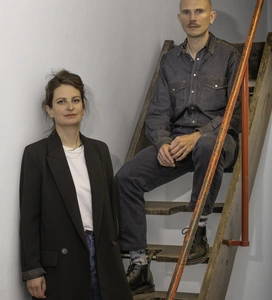
Palace of Un/Learning: Glitching Mies was developed Bernadette Krejs and Max Utech. Several online conversations took place to make the proposal and both arrived to Barcelona on April 25 and participated in other Model events. Glitching Mies created a dissident moment and a participatory action challenging the Barcelona Pavilion as one of the main references in the Modern architectural canon. The Pavilion was queered through questioning and transgressing its hegemonic principles of material, space and use. The never aging image of the Barcelona Pavilion by Lilly Reich with the help of Ludwig Mies van der Rohe and its reconstruction from 1986 displays its fluid spaces and fake realities of a fictional manifesto of Modernism, presenting itself as a seemingly neutral, universal and self-referential architecture icon. As an undisputed reference, the pavilion represents the dominant narrative of the architectural canon: spaces emptied of any domesticity, framed by hard and prestigious materials and homogenous staged elements of objects, people and stories around it.
But every building narrative has its accidents, cracks and glitches that can unleash “phantomed stories” [Jaque, 2020]. Glitching Mies embraces these blurring moments of counter visibility through occupying and irritating the well-known spatial and visual setting of the Pavilion, by transitioning its materiality, its boundaries and hierarchies.
Thereby queering is introduced as a spatial practice for the “enactment of architecture” [Bonnevier, 2007], which implies the possibility to move, to interpret and to open static conditions of the Pavilion by disturbing the order of things [Ahmed, 2006]. This transformation is a joyful act as Paul B. Preciado states, “the crossing is a place of uncertainty, of the unobvious, of strangeness. It is not a weakness, but a power” [Preciado, 2020]. Glitching Mies creates an in-between moment showing the transformative potential of otherness and multiplicity by un/learning and re/claiming the status quo. An ambiguous glitch where questions arise: What‘s good? Who is we? Whose histories are told?
During Model and in the framework of LINA, Bernadette Krejs and Max Utech prepared several interventions at the Barcelona Pavilion, that glitched the usual visual reproduction of the pavilion, interrupted peoples’ flows through space and provoked moments of questioning hegemonic references
in today‘s architecture. Let‘s overcome the submissiveness! Glitching Mies is therefore a feminist, participatory action, “a form of refusal” [Russell, 2020] of a dominant and exclusionary knowledge production and distribution. So everybody is invited to be an accomplice by bringing a small object to the Pavilion and place it in the closet of embodied knowledge and thereby become part of the exhibition. A Cozy (Radical) Salon took place on the 27th of April, the initial point where guests were able to cruise through the installations, share stories on Lily’s bed and discuss their dissident experiences with hosts Bernadette Krejs and Max Utech.
The interventions were presented on 27 and 28 April and the action with the authors and special guests like Irma Arribas (director EINA school of design, Col·lectiu Punt 6, students from La Salle and Equal Saree and two performances with @jayyysees and @iver.z took place on 27 April.