Understanding City Growth _ Toolkit for urban exploration
The accelerated growth of the city caused by a large population influx as a result of political and social changes in the last thirty years has led to major changes in the urban fabric of Belgrade. Citizens of the capital city often talk about the threatened identity of the city, problems in functioning, inadequate infrastructure, pollution. In contrast, there are unquestionable qualities, 7000 years of uninterrupted urban history, the position at the confluence of two large navigable rivers, the overlap of numerous cultural influences, but also countless demolitions and rebuilding as a consequence of life on the limes, turbulent history and war destruction that repeats itself every 40 -50 years. The urban identity of Belgrade is formed by buildings, objects and interspaces created in all historical periods. Cultivating the spirit of a place means recognizing and marking significant memory and material layers of the city.
What today makes Belgrade recognizable on the urban map of Europe is precisely the material testimony of a long continuity of existence through fragments of preserved traces and with the culmination of the inter-war and post-war period of modernism. We invited LINA fellows, young emerging creatives, to Belgrade to give an insight into the development potential of Belgrade from their perspective through various media. This year, the focus is on New Belgrade, more precisely the Bežanija settlement/village and opposed brutalist mega structure of Bežanije blocks 61, 62 and 63. This border territory in permanent transformation, at the meeting point of the rural environment and the structure of mega blocks, is a great challenge for urban planners and architects. The first part of the Understanding City Growth, as part of the 2024 LINA Architecture Programme, the residency period, was dedicated to the research, meetings and workshops. During their stay, LINA fellows, in addition to the opportunity to get to know each other and exchange experiences, achieved cooperation with representatives of various institutions and organizations, local residents and representatives of different generations. The later period, upon their return, was dedicated to analyzing and defining the proposal. The last one was the joint exhibition “Understanding City Growth” during the BINA 2024 festival, organized in the BINA pavilion. For the occasion of the exhibition all fellows gathered again in Belgrade to present their proposals that would contribute to improving the situation and quality of life in the neighborhood, preserving the identity of the place and transformations in accordance with the requirements of modern life and the needs of the residents.
Having in front of us the results of the work of all six LINA fellows teams, it can be concluded that by applying different methodologies, in a certain sense, they all came to similar conclusions. The first obvious fact is that even after almost half a century since the construction of the new housing blocks, there is a clear division between the old rural matrix of the village of Bežanija and these structures of Blocks 61-64. These very different, but very close residential areas largely function separately and without insight into the history of some and the specifics of others. The second conclusion is that since the creation of urban plans relating to the entire territory and since the construction of blocks, there have been significant changes in political and social system, lifestyle and standards and that it is necessary to rethink the situation on the ground and make certain changes that would contribute to the quality of life of citizens.The identity and order of the old matrix of the Vojvodina settlement Bežanija, as the oldest settlement on the territory of New Belgrade, is threatened, and the memory of the place is also suppressed. However, within the settlement itself there are oases of common life and self-organization of residents who are fighting for the survival of their community. It is precisely these values, in the opinion of LINA fellows, that should be preserved and for the purpose of which the community should be strengthened and support provided by the system, through local authorities and institutions for the protection of monuments, culture and education.
On the other hand, when analyzing the blocks created in the period of the 70s of the last century, and which are still being extended, LINA fellows conclude that despite the former planned construction, the passage of time, changes in lifestyle, but also often insufficient maintenance or inadequate use of space, clearly indicates the need to first of all rethink and adapt public spaces to new conditions, habits, but also to global phenomena such as climate change, which dictate different needs of residents. When studying the assigned territory, LINA fellows also recognize positive models of appropriation and spontaneous use of public space by citizens such as spaces for gathering and socializing, bocce ball court, etc.
All these insights, created during a short residential stay, once again confirm how useful exactly this kind of transdisciplinary analysis, contact with the local community and citizens are, as a preparation for further planning and corrections in order to improve the current situation on the ground. A discussion with local urban planners organized during the opening of the exhibition: Božana Lukić (Ministry of Construction, Transport and Infrastructure), Žaklina Gligorijević (Society of Female Architects) and Ana Graovac (New Planning Practice) confirmed this position and indicated the need for precisely this type of analysis and preliminary work that would largely contributed to the quality of urban plans but for which there is often no will due to financial, but also circumstances dictated by the market, investors demands and politics.
Collaboration with LINA fellow Nevena Delić
Toolkit for urban exploration
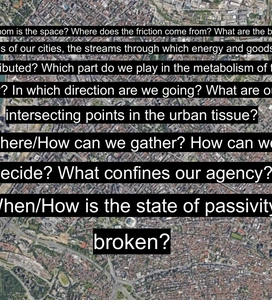
“Toolkit for urban exploration” is a project that looks into the preoccupations and forms of resistance that can be found in the urban tissue of New Belgrade, specifically the area of Bežanijska kosa. Consisting of four scores - a series of participatory and task-based activities, the project unfolds in specific locations that are able to put on display the issue that is being addressed. The project as a whole aims to tackle phenomena such as the tension between the former socialist model city and the new socio-political order, the pressures of commodification, to provide insight into the history of the landscape, as well as to rethink what role vacant and neglected spaces can play in the context of growing peripheries. Public space has always been a precondition for public life, manifestations of collectivity, as well as a stage for negotiating interests, a contested space where frictions appear and where antagonism is the driving force for
change. Looking at New Belgrade, it is easy to perceive the urban struggle and resistance that have culminated over the past years. In a city driven by foreign investors and private capital, there is very little room left for community and free use of public spaces. The green areas are disappearing under the pressure of neo-liberal principles, privatization and profit-driven policies. They are turning into spaces of consumption, to both satisfy and create the needs of a consumer society. On the other hand, certain in-between spaces that are situated within the blocks are showing resistance, they somewhat represent failed utopias, neither serving their original purpose nor adapting to the new socio-political order. They are withstanding commodification, but gradually decaying as neglected areas that don’t have a particularly defined scope. They are in-between, both physically and symbolically. The guides and scores aim to achieve just that: activate these spaces as stages for reflection, non-productive activity and materialize the right for such use of public spaces, as well as question the passivity we have towards the open spaces we inhabit. They will focus on a particular area, but can be applied to any urban context that displays similar currents and preoccupations, they are reproducible and open for interventions. The scores will therefore explore the potential of the undefined, the agency that we have in relation to actively creating and using public space, as well as the pleasure in temporarily reclaiming it and wasting time while doing so.
HANDBOOK 1: Scores 1 and 2
Location: “Livadica”, Marka Čelebonovića 33, 44°49'08.2"N 20°22'43.8"E
Score 1 aims to reflect on one of the most evident examples of urban struggle - the tension between the former socialist model city that intentionally planned and preserved spaces as infrastructure for community and common good, and the new socio-political order that is taking them away. The idea is to occupy oneself with a seemingly banal task of inscribing in space using chalk in order to provide time for necessary reflection.
Score 2 examines the history of the territory you are overlooking, the transformations that took place and allowed for New Belgrade to expand, retracing the horizon that is now obstructed by the built environment. It provides insight into the history of the landscape and its cultural significance, the displacements and alienation that took place within it.
HANDBOOK 2: Score 3
Location: “Filipov park” in Ljubinke Bobić street, 44°81'44.3"N 20°37'26.1"E
Score 3 questions how and to which degree undefined public spaces can accommodate social interaction, and if so, interaction of which kind. The image associated with the word neighborhood is vague, usually stems not from one’s own recollection, but from the generally wide-spread idea of what a neighborhood should be. The surfaces between multiple-story buildings are peculiar in the sense that they are intimate and public at the same time; they are open, yet clearly establish the border between inside and outside; they belong to everyone and no-one, functional and dysfunctional. If all spaces are produced by social relations, as Lefebvre states, the ones in-between buildings most certainly are. With a vague definition and hardly no recognizable common traits, these not-quite parks, not-quite playgrounds and not-quite parking lots can take up different shapes and roles. They bind together, allow interaction and the frequency of interaction that constitutes a neighborhood rather than just a place of cohabitation community born out of inevitability and proximity, becoming both a context and a certain type of commodity, something of service to rely on.
HANDBOOK 3: Score 4
Score 4 looks into the vacant spaces of the city resulting from rapid development and negligence and further examines their potential and the role they play in a transforming landscape. It is based on the notion of theThird Landscape, coined by Gilles Clément, which refers to abandoned territories, spaces that are byproducts of the anthropization of the earth, occurring at the peripheries of a city. According to Clément, all spatial organization generates neglected space. In the context of cities, the most common example is land awaiting allocation or implementation of projects, left undecided and undefined due to provisional political decisions.
The Third Landscape is considered an oversight, a space of unproductivity and indecisiveness, guided by the principle of not doing, an opposition to organized territory; it therefore acquires a political dimension. Clément argues for the moral, political and social deregulation of the Third Landscape, for seeing them as privileged spaces and recognizing their ability to constantly reinvent themselves.
>> Isidora Koščica, Jana Čvertkov and Lana Jeremić
Informal Documents: A series of reflective photographs
Urban spaces are in the state of eternal expansion. In their nature, they are developing, as they suppress and force other environments to retreat. Yet within their own structure, cities are also prone to changes, reflecting the state of the society and spirit of the age with these transformations. If we consider these changes from a distance, we shall see the geopolitical, or historical context (of the creation and growth) of a city. But what happens if we endeavour to seek changes in details? If for a moment we accept the metaphor of a city as a theatrical stage for everyday narratives, we may understand man as the protagonist. Though evidently hidden behind the scenery, man integrates into and interacts with urban space, adapting and shaping it. Human impact inevitably peeks out of the city structures. The project titled Informal Documents tries to research this phenomenon and provide insight into the daily existence of a city through its metamorphoses and micro-changes. By studying these questions, we take the role of a collector, explorer and storyteller of a first-person narrative, as we record the complexities of urban reality.
In its form, the project is an attempt at mapping the neighbourhood of Bežanija, i.e. blocks 61, 62, 63 and 64 and Old Bežanija (Bežanija Village), while the methodology comes down to a series of walks, the result of which is a series of reflective photographs/spatial notes. Due to its history marked with transformations, the space of Bežanija represents a picturesque example of the urbanisation process and its consequences. The modernist architecture of the blocks clashing with that of Old Bežanija leaves the impression of a dichotomy, but simultaneously opens up the question of their similarity. By recording the routes of these unplanned walks through Bežanija, our interaction with the space becomes visible and documented. Through this approach, by exploring and drawing new, informal borders, we map a different Bežanija, shaped through human agency.
By using the media that are in their essence documentary and artistic, the project exists on the edge between art installation and archive. In this sense, the photographs and maps keep their dual function. On the one hand, they are the documents of the research process, while on the other, they represent attempts to catch and record the ephemerality of the city: the city as is now, as a reflection of the society, which tomorrow will have undergone some other transformation already. In spite of this transformative force of the city (or even being influenced by this very force), Informal Documents are an attempt to fix an urban portrait, with all its specific traits, permutations and the influences that shape it.
>> Sara Ramezani
Documenting Public Spaces in the Bežanija Blocks
This project is dedicated to using the power of photography as a means to document life within three blocks in New Belgrade (blocks 61,62 and 63), showing the complex relationship between public space and its users. Based on plans and designs from the early 1970s, these blocks were precisely planned, where careful consideration was given to the intermediary spaces between them. By comparing the original plans and designs with how public spaces are being used today, differences become apparent in their functionality and community utilization.
The photographic collection is organized into three categories, each offering different insights. The first category focuses on public spaces intentionally designed for specific activities, such as shopping or social interaction. Through captured images, viewers can understand how people engage with these spaces as intended by their original design.
The second category delves into the spaces initially designated for public use but now serving a different purpose. These areas, often small open spaces between the buildings or corridors connecting the blocks, have been observed to be neglected or underutilized, diverging from their intended role as communal gathering spots. This disparity is depicted through photographs, showing the lack of adaptation of urban spaces meant for communal gathering, or public spaces being used in a completely different manner.
Finally, the third category explores spaces not originally conceived as public areas, yet which have undergone unforeseen transformations over time. These transitional spaces, such as makeshift pathways through the greenery, improvised gathering spots, or even the ever-growing parking area, offer valuable insights into the organic or semi-organic evolution of urban environments and the fact that just as much as space shapes people’s lives and behavior, people also affect and shape the space to adjust it to their needs.
Besides that, photographs provide an overall insight into how the space between the buildings is being used, who are the main users and how it’s been maintained. Also, it provides a slight evaluation of urban design qualities such as livability, sense of belonging, safety, sense of security, human scale, greenery, and so on.
By showcasing the life within these public spaces, the photographic collection provides a window into the dynamic interaction between urban design and the evolving lifestyles of inhabitants, highlighting the flexibility and ingenuity characteristic of urban communities.The Realization of the LINA/BINA Project “Understanding City Growth” was supported by the citizens' association "Stara Bežanija", Elementary school "Jovan Sterija Popović", Language school "Junior", Cultural Center of Belgrade, Faculty of Architecture, Faculty of Fine Arts, Belgrade, PUC Greenery Belgrade, Institute of Architecture and Urban & Spatial Planning of Serbia