Living Makeshifts Summer School _ Chronicles of the summer school
Since the beginning of the Living Summer School, our small organising team always had a wish to experiment with construction practices within our yearly programme. In the previous summer school editions the participants' tangible outputs were realised in prototype form and on a small scale. As an organisation we experiment with changing elements of the programme and we were interested in witnessing how our pedagogies would be shifting if we changed the type of expected output. Additionally, we have always been lucky to be rooted at Bolwerk where building with reused materials and handicraft are core to the creative practice, so this wish to confront ourselves with construction came quite naturally. However, we were dubious about the right approach, not wanting to be building for the sake of building. Therefore we wanted to define our approach to construction as tangible expressions of an intention, with a configuration that is open to adaptations. That's when the yearly theme emerged, "makeshifts" allowed us to perfectly translate our conceptual approach to construction.
Moreover, this theme is perfectly inscribed in the trajectory of the past LSS editions, where speculation and design fiction were important elements, thus intending "makeshift" also as a manifestation of a speculative vision (make - a - shift). Construction became for the LSS a medium to embody alternate visions of socio-environmental systems for the near future. This approach also opposes the top-down approaches to urban planning and architecture brought by modernism, that imposes an hyper-regulation and definition of the built environment, normalising and flattening our surroundings.
As a European organisation, we also wanted to reflect and bring to the table current trends unfolding within the European Union. From our research it emerged that in 2018 alone, 4.2 % of European land cover was lost to construction: that's an average of one basketball court per resident. In light of the imminent dangers that this poses to the planet, the European Commission has declared a "zero net artificialization" policy for 2050. This means that new development projects will be limited to available built-up areas. This will be a radical shift from the expansionist urbanisation of the last century. Failing to meet this objective will accelerate the current climate crisis and also make us less resilient to the change it will bring about. This, further pushed us, as Euroropeans to affirm that:
We need to shift the way we make space by using what is readily available.
Learning and "Makeshifting" Process
The LSS employs a project-based learning approach in its pedagogical ethos. Participants work in teams based on their interests, skills, and experiences and they collaborate closely with a network of local partners, including non-profits, private entities, and the government sector, who are relevant to the yearly theme. This is our method to transmit territorial innovation, valuing local and contextual knowledge from community partners as a learning resource. The vibrant exchange and collaboration between Kortrijk's community and participants is an essential component of our project-based education.
In preparation to the summer school, our team carried on-site research and scouting connecting with the local community to find the most appropriate sites that could be involved in experimental construction practices:
- the adventure construction island Wildernis
- the ecological farm Heerlijkheid van Heule
- the cultural free port Bolwerk
Who all expressed an internal wish to build something tangible with their local community embedding the skills and knowledge participants brought with them. In the initial scouting phase, over ten local stakeholders were considered. These three sites were selected as the most fulfilling due to their ideal balance of rural and urban connection, local and international rootedness, and a clear, tangible need for construction.
Every partner also brought with them several other stakeholders that were put in touch with summer school participants:, respectively
- LZSB, a collective of local cultural organiser who create interventions in the public space and the Gevelgang, a cargo bike-based local group which creates green interventions to bind communities together
- Oranjehuis, a local non-profit organisation that creates opportunities for integration for youth at risk
- The municipality of Roeselare and its youth department which were the ultimate custodians of the project which was being developed at Bolwerk
Once the partners were individuated we opened a consultation period with alumn*, participants of previous editions, who through online workshops contributed to shaping the summer school programme, teaching and facilitation methodology.
Recruitment of Participants and Fellows
In parallel to the field trips and the consultations with alumn, we were also looking to recruit participants for summer school as well as LINA Fellows to participate in the 2023 LSS.
Participants, as every year, are recruited through an open call. To answer this open call prospective participants need to introduce themselves, their backgrounds and past experiences, but mostly they need to express their motivation to participate in the LSS. This aforementioned point, motivation, is the most important criteria to be selected, we prioritise participants who express a clear will to immerse themselves in a highly collective experience, who are self-guided and who care deeply for the topics at hand. The LSS does not discriminate between prospective participants based on their educational and professional background, socio-economic provenance. For the 2023 edition, applicants were solely able to apply from one of the 4 European countries that are covered by our Erasmus+ Consortium : Belgium, France, Italy and the Netherlands and needed to be under 30 years old. This allows us to offer a completely free experience to all participants as their living and transportation costs can be covered by the Erasmus + funds.
The call for this year was disseminated through various channels, naming a few:
- LINA website
- The network of universities of the Start@K programme, the Kortrijk-based VLAIO network that supports youth entrepreneurship
- JINT, the Flanders' agency for Erasmus+ Programmes
- ArtRabbit, a website for artists opportunities
- ArchDaily, a website for architects opportunities
- Art Connect, a website for artists opportunities
On social media, mostly Instagram, it was shared by the accounts of the aforementioned partners as well as art, architecture and Erasmus+ opportunities aggregators
We received more than 70 applications from which we, the organising team, selected 24 participants with the criteria set above. The 6 additional spots were reserved for returning alumn*, who can continue the transmission of knowledge from one year to the next. We always try to maximise the diversity of participants and in order to reach locals from marginalised backgrounds we work with JINT and other local non-profit organisations and NGOs that are based in Kortrijk. Despite our efforts, the theme and the communication strategy appealed to a lot of architects who constituted the majority of our participants. Additional backgrounds were: biology, environmental engineering, business and entrepreneurship, NEET (Youth not in employment, education or training), fine art, graphic, product and system design.
When it comes to selecting the LINA fellows we adopted similar selection criteria. In particular we wanted to prioritise young practitioners, possibly under 30 years old, to offer them a platform that could uplift their work and practice. We were interested in practitioners who could provide inspiration to the participants by breaking the boundary of formal presentations and mentorship. We also wanted to prioritise fellows who had already experienced a residential approach and who could contribute to the ethos of the LSS with reflections brought by an observational practice. Lastly, it was important that they brought to the LSS a strong research and conceptual approach which translated into an interesting practice.
Our two first picks were the artist Jonathan Steiger and the collective Studio Inscape.
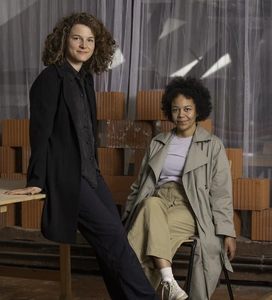
LINA fellow Studio Inscape
Studio Inscape was founded by Eileen Stornebrink, Willie Vogel, and Charlotte von Meijenfeldt. Only Willie and Eileen engaged with us as a fellow, together with their collaborator Alessia Liscia. As a team trained in architecture and urbanism, they focus on translating eco-philosophical theory into practice, expanding architectural approaches through notions of biology and system theory. Their approach, rooted in systems thinking and action, contributed to bringing a more complex perspective to the educational experience and promoted sustainable, forward-thinking architecture that cares for multiple agents. Moreover, Studio Inscape's approach to architecture, viewing it as a continuation of and attunement with its environment, fits seamlessly with the Summer School's mission to foster territorial innovation and address socio-environmental issues. Their work, which sits at the intersection of research and fabrication, explores spatial strategies, experiences, installations, and architectural projects, contributing to expanding the imaginary of potential outputs and design interventions to be devised by participants.
After one introductory online video call we understood this collaboration could bring mutual growth, moreover they liked the project and the proposed collaboration format, so they accepted the collaboration. Two more online video calls were scheduled in preparation for their involvement in the LSS2023.
Activity: Living Makeshifts
During the Living Summer School week, participants engaged in a variety of activities that emphasise community, learning, and environmental interaction. Each day was punctuated with collective moments of conviviality, such as shared meals and group discussions, fostering a strong sense of community. To explore the local area and understand its environmental connections, bicycles were provided, allowing participants to embark on cycling excursions that facilitated deeper engagement with the surroundings.
Accommodation was provided at DOK27, a large hangar restored with shipping container architecture by the Gavers Lake. This affordable and communal living space was ideal for hosting the summer school group. Cooking together was also a central activity, reinforcing the value of shared labour and care, which was seen as an integral part of the learning experience. The activities described and the overall time-organisation can be appreciated through this timetable.
A large portion of the time was, of course, dedicated to construction activities, letting participants grapple with the production of space involving peers and partners from different sectors with varying expertise, imperatives and visions of the future. From Tuesday onwards participants were exploring ideas and getting hands-on experience in making scale 1 interventions with local partners. The three interventions that were built over the course of the week were:
- A modular play-system that would preserve and foster biodiversity for Wildernis
- A composting toilet and recycling unit on a trailer for the Heerljikheid Van Heule
- An hacked caravan to be used as a social and cultural centre for Roeselare municipality in connection to Bolwerk's youth programmes
Directly addressing the needs of our partners, all these interventions merge social and environmental issues that are currently faced by our partners, fostering social cohesion, environmental awareness and the employment of sustainable, clean or recycled materials.
The conversations and reflections revolved around the deconstruction of hardwired building common-practices to investigate more sustainable, emergent life cycles for our buildings, from design to build, maintenance and deconstruction.
The program, for its third consecutive year, reinstated the power of collaboration, cooperation, and collective effort, viewing them not only as radical acts during times of crisis but also as significant drivers of meaningful outcomes.
Studio Inscape's Contribution
On Tuesday 05.09.2023, Studio Inscape gave an in-depth overview of their portfolio of past and on-going projects, covering the stories of places and people involved. They started by introducing their ethos, sharing notions of Latour's actor-network theory and reflecting on how to work with complex systems in an architectural practice. For each project they delved deep in the process, tools and methods used giving tangible advice to participants who might want to embrace a similar career in the future.
They concluded their lecture by sharing with participants a system's mapping methodology that they devised by altering one of their tools to fit the LSS context. This mapping tool and method was later employed by LSS participants to map the agents of their construction sites.
The findings of this mapping exercise were then expanded on and further developed in Studio Inscape article "Gestures of maintenance - Chronicles of the summer school by Studio Inscape". The article was the culmination of an eye-opening process initiated by Studio Inscape that supported the LSS cohort in reframing their work as inscribed within more-than-human systems and complex networks.
Outputs
Three main outputs emerged from the activity:
Living Prototypes
The three architectural prototypes or "living prototypes" are the most outstanding outputs of this edition of the LSS, they stand as prototypes of sustainable construction and regeneration. They will be tested and lived by our partners and their construction process will be the departure point of the 2024 LSS (see "Looking Forward" section).
Open Day
During the summer school, on Thursday 07 September 2023, the Summer School opened its doors to the general public to welcome an exchange with the local community and international experts before the finalisation of the built interventions.
78 visitors (university lecturers, NGO representatives, policy and decision makers, …) came to the event to network and connect with LSS participants. Two local institutions Leiedal and Designregio, gave two opening masterclasses in preparation for the participants' presentations to the public of their interim process.
Book
The LSS team has produced a book documenting the experience of the LSS24, this is a registered publication with a dedicated ISBN. The book contains not only the articles produced by the fellows, but also writings from the participants, interviews with local partners, articles by researchers and photographic documentation of the experience. This book will be registered as part of the LINA library that LINA member and publishing house dpr Barcelona is collecting and disseminating.
Outcomes
The LSS team has embarked on an ongoing journey to pursue its values through its yearly program. Some of them clearly align with LINA's overall themes, values and objectives. Our Activity "Living Makeshifts" let the LSS team and its network of allies, partners and participants achieve the following outcomes:
- Furthering Experimentation with Alternative Education Systems:
- With "Living Makeshift" we continued our efforts of affirming informal education as a platform that can challenge, nourish and complement traditional educational paradigms within architecture. Our emphasis on experiential learning, multidisciplinary collaboration, and direct community involvement fosters a new model of education that is dynamic, practical, and deeply connected to societal needs.
- Increasing Sustainability:
- Every year we try to grow incrementally and measurably towards having a positive impact on our environment. In 2023 we added to our practices the consumption of proteins from Food Act 13, to complement our locally farmed diet and composting all the food scraps.
- The design interventions we created prioritise the use of circular materials and sustainable practices, ensuring that the projects are environmentally responsible and capable of being maintained over the long term. This commitment to sustainability extends to both the physical structures and the social systems they support.
- This experience in construction reinforced and enhanced our community's knowledge and skills in circular building practices.
- Bridging the Urban-Rural Divide:
- By continuing our experience in a mid-sized city we aim to challenge the notion of cities as poles of cultural wealth. We shift the power dynamic by uplifting local territorial leaders as tutors and sources of knowledge, resources and skills that can represent the geography-specific wisdom of local communities.
- Building Community:
- Community engagement is integral to our approach. By collaborating with local partners and involving community members in the design and implementation process, we build strong, supportive networks. This fosters a sense of ownership and shared responsibility for the interventions, enhancing community cohesion and empowerment.
- Reducing Inequality:
- Through inclusive practices and continuous learning, we aim to reduce inequality especially within architectural practices. Our experience is designed to provide equal opportunities for all participants, regardless of their background, and to address disparities within the communities we serve. We apply continuous learning practice to lower the barriers of access to this opportunity for people from marginalised backgrounds.