Periple Duet _ Universally Specific

In this first edition of Periple Duet, the Lisbon Triennale convenes these two LINA Fellows to, from
March to May, create and undergo a thematic itinerary that unites the city where they live with Lisbon and back. The journey provides the raw material for an exercise in observation: crossing borders, experiencing territorial diversity, reducing distances, and expanding boundaries are key elements addressed in a travel journal as an essential tool for continuing education in architecture.
On May 26, Ajda Bračič and Tevi Allan Mensah returned to Sinel de Cordes Palace, Lisbon Triennale headquarters, for the On-the-move residencies Talk to present their experience of traveling through over 20 cities, joining Portuguese professionals for a reflection on architecture and landscape framed by notions of border, fluidity, mobility, or heritage, both material and immaterial.
Project
In this first edition of Periple Duet, the Lisbon Triennale convenes these two LINA Fellows to, from March to May, create and undergo a thematic itinerary that unites the city where they live with Lisbon and back. The journey provides the raw material for an exercise in observation: crossing borders, experiencing territorial diversity, reducing distances, and expanding boundaries are key elements addressed in a travel journal as an essential tool for continuing education in architecture.
On May 26, Ajda Bračič and Tevi Allan Mensah returned to Sinel de Cordes Palace, Lisbon Triennale headquarters, for the On-the-move residencies Talk to present their experience of traveling through over 20 cities, joining Portuguese professionals for a reflection on architecture and landscape framed by notions of border, fluidity, mobility, or heritage, both material and immaterial.
Briefing
A briefing was shared, defining in detail the project Premises, Considerations, Essential rules and Deliverables.
"The architectural journey marked contemporary architectural thinking and production, both because the experience of travelling revealed that knowledge in architecture necessarily incorporates a sensory approach to the built space, and because history was rediscovered as a far more fruitful design tool than a catalogue of styles."
José Fernando Gonçalves, in Em viagem – experiência, conhecimento na arquitectura portuguesa do século XX.
"Travel is a powerful force in shaping the perception of the modern world and plays an ever-growing role within architectural and urban cultures. Inextricably linked to political and ideological issues, travel redefines places and landscapes through new transport infrastructures and buildings. Architecture, in turn, is reconstructed through visual and textual narratives produced by scores of modern travellers — including writers and artists along with architects themselves. In the age of the camera, travel is bound up with new kinds of imaginaries; private records and recollections often mingle with official, stereotyped views, as the value of architectural heritage increasingly rests on the mechanical reproduction of its images."
Deriu, D., Piccoli, E. and Turan Özkaya, B., in Travels in Architectural History, Architectural Histories, 2016.
An exchange responding to the mission of a shared plural, free, and open space. An on the move residence of a territory-crossing itinerary in Europe carried out exclusively through land transportation. Each fellow will propose an approach to the briefing based on their previous research on the launched subject and will implement it by working in close relation with the several departments of the Triennale executive team.
With three rounds, generating a collection of Periple Duet, these original contents will be hosted on the Lisbon Triennale website and sharing platforms.
> Considerations
Reflection on architecture, territory, and borders, along with the geopolitical issues that the experience raises. The journey is the raw material for a narrative-based exercise of observation, analysis, and thinking. Crossing borders, experiencing territorial diversity, reducing distances, and extending limits are key elements addressed in a travel log as an essential tool for continuous training on architecture.
Encourage land mobility suiting the environmental challenges, better using the existing infrastructure, and showing what could be optimised. Materialise an observation that can be useful for urban planning and territorial management to fit with the European Green Deal.
Advocate the freedom of people's circulation and the fluidity in the European territories in favour of a diverse region of peace, movement freedom, and free expression.
The output is a learning tool with a long-lasting effect that can be shared and spread inside and outside European frontiers. Accessibility and inclusivity are also thematics of interest for Triennale activity.
> Essential Rules
For the journey use only collective and terrestrial transport systems, although there can be exceptional water connections. The itinerary connecting the city where you live to Lisbon can be direct but it is also allowed to define a larger, looser thread route considering the chosen concept.
The language must be English. If the output includes interviews, take into account diversity and gender parity. Aim to reach a wider audience avoiding it being tailored only for the architecture community.
Seek to be accessible, relaxed, and engaging storytelling. Maximum length: for critical essay, 10.000 characters; 30 min for each audio or audiovisual essay.
> Deliverables
A written, aural, visual, or combined essay. Can be a single piece or a series of smaller episodes.
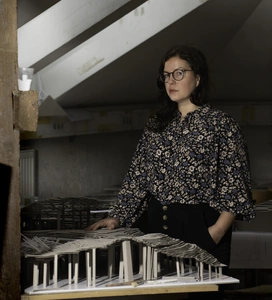
Ajda Bračič Periple: Universally Specific
Chosen for her experience as a culture critic and editor in various media and for her work as a fiction writer, Ajda Bračič starts her journey in the picturesque city of Ljubljana, more than 2000 km away from the Portuguese capital. Sustainability and adaptive reuse are some of her main interests, focusing on the intersections between architecture, identity, and language that can be found in traditional constructive knowledge, details, and techniques across different communities.
Starting and ending in her home in Ljubljana, Slovenia, from April 17 to 28 Ajda Bračič travelled through 10 cities in 6 countries, using the train as her designated transport. Her mid-way stop in Lisbon from April 21 to 23 enabled her to know more about the Lisbon Triennale and its team, and was the perfect opportunity to do a situation status on the residency.
She developed an intimate travel diary spawning twelve fragments, one for each day of train travel
between Ljubljana and Lisbon. Focusing on the correspondences between language and space, she examines in a non-linear way how words and architectural ideas have always migrated and traveled, ignoring borders and creating identities that continuously overlap. Her journey is told by her in a short 12 episodes that incorporated a small booklet and are the basis of a podcast.