TRANS - oikeology
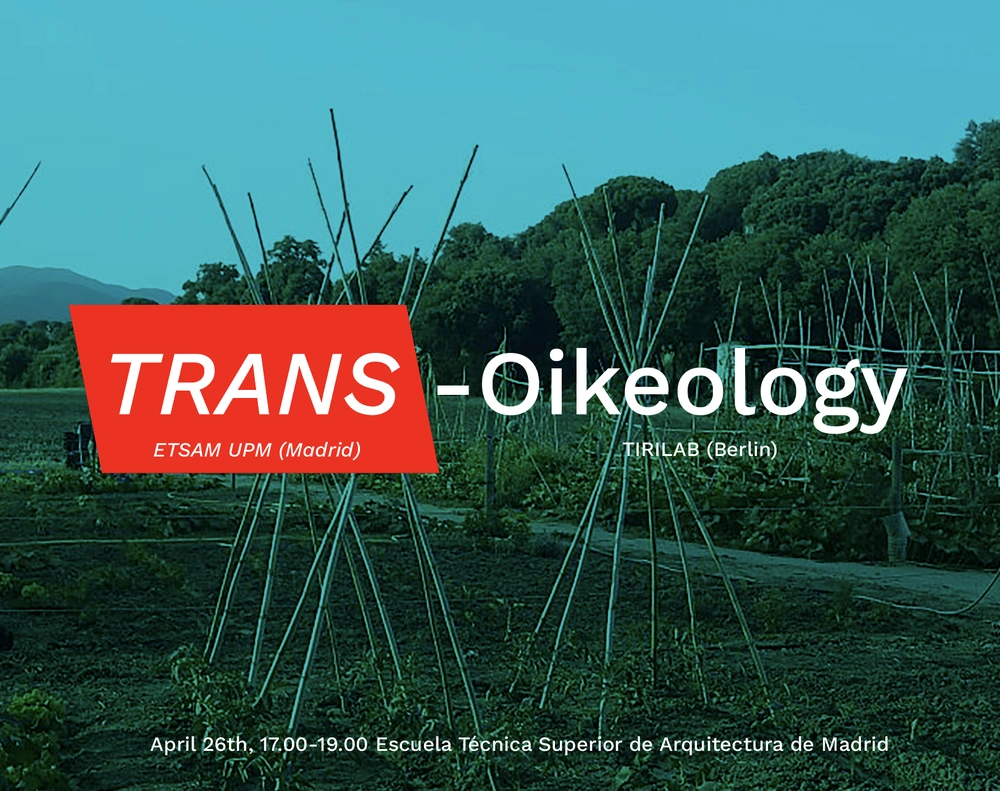
TRANS is the name of a research group called The “Observatory of transdisciplinary practices in architecture”. It is a collaborative organization belonging to the Universidad Politécnica de Madrid that, from the Department of Architectural Projects, promotes the interconnection with other other areas of knowledge, other national and international research centers, and with other companies and institutions of public or private character.
Our approach is very practice-oriented. It lays within the crisis of architecture as discipline. TRANS is an open structure that explores intersections and shared spaces between areas of knowledge and emerging contexts in order to rethink and build new scenarios of architectural practice. Its main objective is to connect the challenges, emergencies and contemporary cultural innovations with a transformation of the agenda of our discipline, thus enhancing the real impact of trans-architecture in our society. In this first experience TRANS, along with the fellows from TIRILAB, will work on the ways the architectural practice might engage with a territory that presently is in profound crisis in our country, the rural, and how to collaborate with diverse agents which are working in this direction.
This event was celebrated in the context of the activities of Departamento de Proyectos Studios. Specifically, within the DPA Studio. The Limits of Water, co-coordinated by Juan Elvira. With the precedent of numerous studios held around productive landscapes in deteriorated rural areas, The limits of Water looks at the most vulnerable ecosystems that are subject to profound transformations: those that have a special dependence on water processes, regardless of their nature.
Desertification associated with prolonged droughts, water pollution caused by industrial activity, or the rise in sea levels are all processes that have a strong impact on the territory, its ecosystems, and human activity. We will be working in one of these enclaves, the Albufera of Valencia, a landscape full of uncertainties in its ecological, productive, and ethnographic dimensions.
The course is divided into two fundamental parts. The first part, lasting approximately four weeks, will involve group research on case studies of wooden architecture in relation to aquatic environments. In the second part, we will develop a project with a common program for all students, building upon the knowledge gained in the previous part, situated in the shared location of Albufera, Valencia.
Oikeiôlogy: Practices on Natural Mythologies
On May 5th 2020, in the midst of an unprecedented health crisis, the Greek government passed a new law titled: “Modernisation of Environmental Legislation” which eliminates the protection of Natura 2000 sites all over the country, and commodifies the landscape promoting mining, investment projects, the expansion of the industrial and new construction activities.
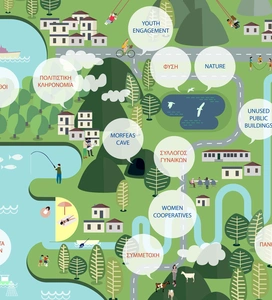
Thespotia region is facing a great challenge since it includes more than 40% of natural protected areas providing a landscape economy for the communities around them and a rich mythological cultural heritage. The population in these scattered communities have lessened almost a half in the last decade, resulting in abandoned schools, neglected public infrastructure and forgotten local technologies. Through Oikeiôlogy, we integrate bounding and engaging methodologies, in order to create encounters and activities, re-appropriating the abandoned school buildings as community spaces. Together we create specific working groups, joining women initiatives, students, local community stakeholders and civic professionals.
The multilayered identity of rural communities in the inland is rooted in the territory: the valleys are shaped by the ingredients of traditional culinary techniques, defined by mythological topologies, and articulated through a cohesive network of women cooperatives. We propose an ecosystemic approach where importance is given to human and non-human bodies. Our aim is to learn from lifelong relations between communities and natural bodies and co-create prototypes that can foster them. We have mapped and identified a variety of self-organised initiatives mostly by women that we recognise as rural commons. Oikeiôlogy aims to join these initiatives and the communities around them, establishing a system of overlapping networks that will reinforce new collaborations towards a more cohesive territory.
MORPHI WORKSHOP PRESENTATION.
The workshop that will be held in Morphi (Greece) was presented to academics and members of TRANS, as well as to the general public, which was formed by numerous students interested in attending the topic.