Shared Ground: Translating Coexistence
Márta Schermann
András Sereglei
Sára Törley-Havas
I am a Hungarian artist-researcher working at the intersection of spatial practice, participatory artistic research and speculative interfaces. My work explores how site-specific artistic interventions reveal relationships between people, places and more-than-human species through collaborative research, storytelling and interactive public installations.
My background includes visual art, spatial-based scenography, and participatory and community-based practices. These experiences inform my current focus on participatory artistic research. I develop projects that combine fieldwork, interviews, workshops, mapping and speculative interfaces to investigate how public space is experienced, negotiated and collectively shaped.
I see participation as a form of shared authorship. I create open frameworks in which local knowledge, lived experience and situated narratives shape both the process and the final work. My projects take the form of interactive installations and public interfaces that translate collective experiences into spatial encounters.
My projects connect artistic research, spatial practice and public participation through collaborations with cultural institutions, municipalities and local communities in Hungary and internationally.
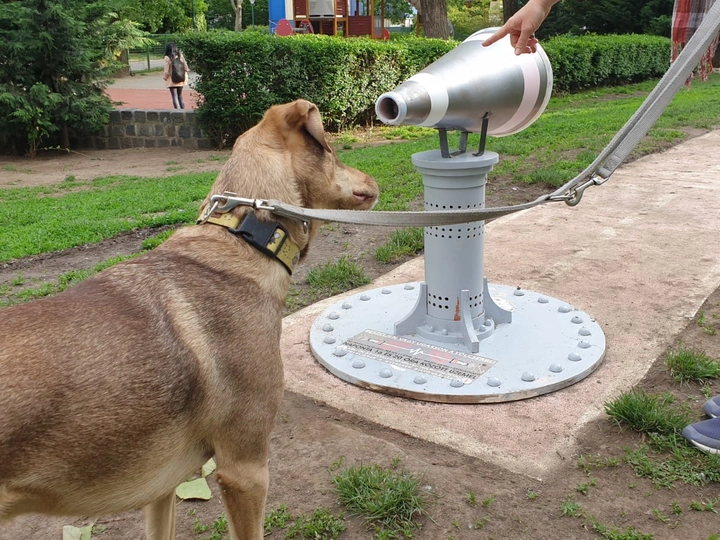
This is a participatory project centred on a speculative multimedia Dog–Human Translator. Developed in a public park in Budapest in 2020–2021, it responded to a site where a children’s playground and a dog run were separated. Families arriving with both children and dogs could not use either space together. During the Translator’s two-week installation, the area around it became a shared space where children, dogs, caretakers and passers-by gathered, played and interacted.
The project explored the dog as a family member. In community-based storytelling sessions, dog caretakers shared experiences of care, conflict, humour and companionship. Their accounts became the source material for the Translator’s responses.
The Translator uses a deliberately non-AI-based technical system. Its staged promise of translation—from dog to human and from human to dog—reveals human expectations, projections and emotional relationships with more-than-human species. Speaking into the device and listening to its responses created a playful situation in which interspecies relations became visible and open to discussion.
Within LINA, I would develop the Translator as a transferable framework for investigating how interspecies relationships are shaped, accommodated and negotiated in different urban environments. New iterations could begin with dogs and expand towards other species that share cities with humans, including birds, insects, urban wildlife and plants. Each version would emerge from its local ecological and social context through fieldwork, observation, interviews and situated storytelling. These materials would form a new site-specific “translation” system and a public spatial intervention.
The project asks how humans imagine, organise and negotiate coexistence with more-than-human life. By making local assumptions, attachments and conflicts audible, the Translator creates a shared setting for reconsidering how cities accommodate different species and forms of life.