WetLandScape: Regenerative Futures for Kakhovka
I am a Ukrainian architect, researcher, and educator based in Germany. My work operates at the intersection of participatory design, regenerative construction and material research, exploring how architecture can foster ecological regeneration and strengthen communities affected by environmental transformation and war. Through design, practice-based research, teaching, and interdisciplinary collaboration, I develop spatial strategies that connect local knowledge, circular material systems, and community resilience.
I hold a Master of Arts from Alanus University (Germany) and a Master of Architectural Environment from the PDABA (Ukraine). I am a registered architect with the National Union of Architects of Ukraine. Until 2022, I led my architectural practice in Dnipro for nine years and co-founded the participatory urban initiative Сад Поруч (Neighbourhood Garden)
Being displaced by Russia's full-scale invasion fundamentally transformed my practice, reinforcing my commitment to community-led design and regenerative approaches to reconstruction.
My recent work focuses on bio-based materials, participatory reconstruction and post-war recovery. Between 2022 and 2023, I researched energy-efficient reconstruction of war-damaged schools in Ukraine through a fellowship funded by the DBU Foundation. From 2024 to 2025, I led the participatory planning process for the Mykolaiv Water Hub, co-developing reconstruction strategies with local communities and interdisciplinary partners.
Alongside my architectural practice, I contribute to international exchange on architecture, sustainability and reconstruction. I am a board member of Women in Architecture Ukraine and I have been invited to speak at platforms including Woche der Umwelt, Café Kyiv, and Recovering towards NET Zero. As a lecturer at Alanus University, I encourage students to explore regenerative futures through material experimentation, climate-responsive design, and socially engaged architectural practice.
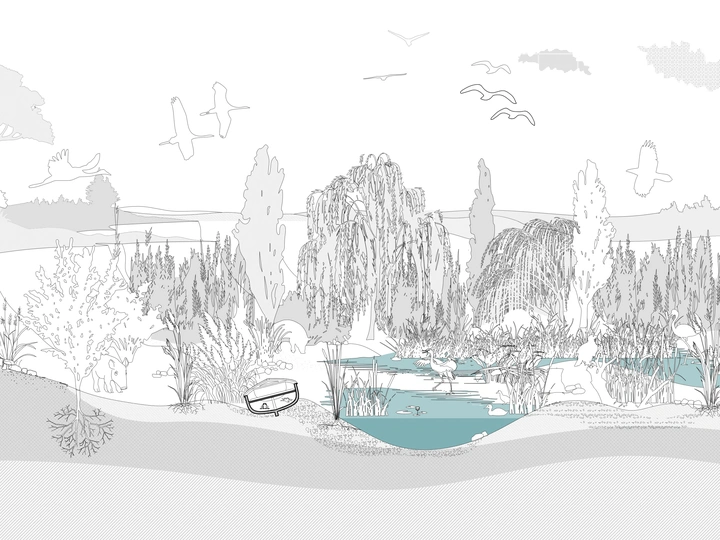
The destruction of the Kakhovka Dam in 2023 triggered one of the largest rapid environmental transformations in contemporary Europe. As water receded from the former reservoir, a new wetland ecosystem emerged across more than 2000 km². While often framed as an ecological disaster, this transformation also presents an opportunity to rethink post-war reconstruction through local resources, ecological regeneration and community resilience.
WetLandScape investigates the potential of biogenic materials growing within this new ecosystem. Reeds, cattails and sedges were once central to vernacular building cultures in southern Ukraine but largely disappeared with industrialisation and the dominance of extractive building systems. Today these materials are abundant again, yet practical knowledge, tested applications and local value chains remain underdeveloped.
Since 2024, I have been conducting practice-based research on the architectural use of paludiculture materials from the former Kakhovka reservoir. Through collaborations with researchers, architects, craftspeople, local communities, I have explored how these materials can contribute to reconstruction while addressing challenges such as water scarcity and climate adaptation.
Building on this work, this fellowship would support collaborations between Ukrainian and European experts, local communities and practitioners, allowing research to be translated into spatial practice. Through workshops, field research, hands-on experimentation and prototyping (construction of a pavilion), I aim to develop implementable building solutions rooted in local ecosystems and cultural traditions, documenting it in an open-source material catalogue. The project reframes the post-dam landscape not as a damaged territory awaiting restoration, but as a regenerative environment capable of generating new forms of construction, knowledge and social resilience. It explores how new ecological realities can reshape the future of building.