Unstable Alpine Monocultures: From Apples to Data
Sonia Sobrino Ralston
See-Saw is an interdisciplinary design practice led by Simon Lesina-Debiasi and Sonia Sobrino Ralston in the Italian Alps. The practice works and teaches across architectural, infrastructural, and environmental systems, with projects ranging from built work to installations and digital media. See-Saw focuses on adaptive reuse in agricultural landscapes, especially where plants and existing infrastructures are under pressure from climatic and technological instability. Adaptive reuse extends to media: the practice uses salvaged electronics and open-source software to examine how computing infrastructure reshapes environmental and social conditions.
Simon Lesina-Debiasi (Italy) is a designer, researcher, and artist whose work addresses overlooked infrastructures, their civic potentials, and the environmental impact of digital sensing. He served as the Postgraduate Teaching Fellow in Architecture at MIT, where he received the Thesis Prize for his work on sensing in building systems. Previously, he taught at Northeastern University and worked at Landing Studio. His installations have been shown at the MIT Media Lab, MIT Artfinity, and the São Paulo Architecture Triennale. He holds a SMarchS in Design and Computation from MIT, an MArch from Princeton and a BArch from the Academy of Fine Arts Vienna.
Sonia Sobrino Ralston (Canada) is a designer, researcher, and educator, and the Daniel Urban Kiley Teaching Fellow in Landscape Architecture (2025–2027) at the Harvard GSD. Her work examines how plants and information systems collide and its social, political, and spatial effects. She received the Architectural League Prize in 2024 as part of Office Party and assistant curated the 2022 Tallinn Architecture Biennale. Her work has been exhibited at venues including the Venice Architecture Biennale, Beta – Timișoara Architecture Biennial, and the Arnold Arboretum. She holds an MLA from Harvard, an MArch from Princeton, and a BA from the University of Toronto.
Deep in the underbelly of the Alps, abandoned mines and bunkers are being transformed into repositories for digital information. The mountains’ ostensible geological permanence is considered ideal for data centers: constant temperatures, stable humidity, and rock shielding are marketed as protection from climatic and political instability. The obdurate mountain becomes infrastructure for digital memory.
Across the Alps, underground data centers are promoted as rural economic opportunities to secure Europe’s digital future. In Trentino, the DataMine project opened in 2025 in a former mine to store servers alongside apples. Such facilities form a wider network of infrastructure, platforms, and protocols that underpin what some call an “internet monoculture”: a small number of companies owning and operating systems that produce a homogenous digital experience. Below the mountains, a monoculture for storing data—and memory—is emerging.
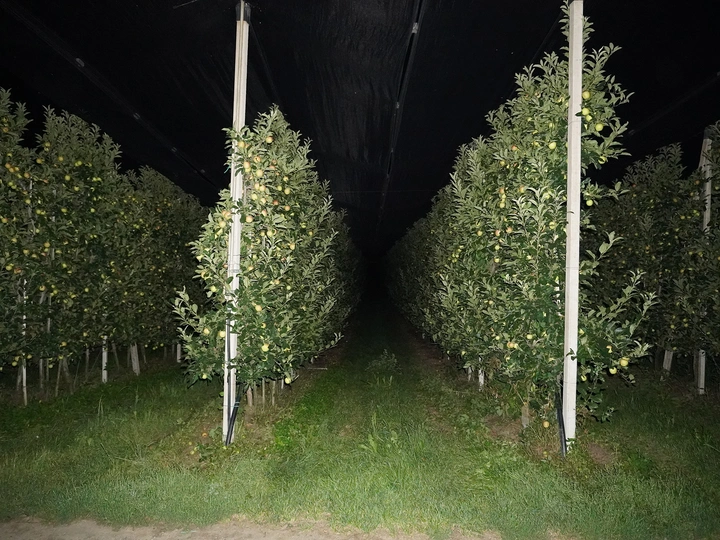
Aboveground, another archive faces extinction. Since the 1950s, industrial apple monocultures have replaced diverse rural landscapes in Alto Adige. Traditional orchards, mixed farming, terraced cultivation, and local seed varieties have given way to standardized production, driving biodiversity loss and eroding situated ecological knowledge. Local knowledge of plants for food and medicine—once passed through generations—are disappearing as the Alps warm at twice the global average and species are forced to migrate or vanish.
Examining these monocultures—digital and agricultural—we explore how both might be “rewilded” in Alto Adige, and how they relate to environmental knowledge. Based in Val Venosta, we will interview “farmers” of data, apples, and small‑scale traditional plots, and use recordings, field sound, and digital animation to create a multimedia archive. The work, shared across the Alps and beyond, reflects on monocultural systems and offers glimpses of wilder paradigms that respond to, rather than deny, instability.