Memory In Motion
Bogdan Seredyak is a Ukrainian-born architect and multidisciplinary artist whose work spans spatial design, urbanism, and emerging technologies. In 2012 he graduated from New Jersey Institute of Technology, Faculty of Architecture and Design. Since establishing his solo practice in 2018, he has focused on creating interactive environments through conscious design, site-specific installations, and architectural projects grounded in urban and social research. His practice spans immersive multimedia installations, visionary projects, and experimental designs, connecting local contexts to global narratives and addressing urgent societal and planetary challenges. Through his design studio, he operates across architecture, art, and politics, fostering dialogue, experimentation, and systemic reflection. His recent work explores themes of post-war reconstruction, collective memory, and cultural identity. Currently based in New York, USA, Bogdan has presented his work internationally, including his latest exhibitions - Suspended Landscapes at Treasure Hill in Taipei, Taiwan, and Memory in Motion at the Dordrecht Museum of Art in the Netherlands.
My aim with this body of work is to examine the ideologies of post-war reconstruction. I left Ukraine for Rotterdam one month before the full-scale invasion began, where I was participating in an urban research workshop. When the war started, my priorities shifted. While in the Netherlands, I developed a reconstruction methodology using Rotterdam—a city devastated during the Second World War and later rebuilt—as a case study. I then began applying this approach to the Ukrainian context, resulting in the following project.
Architecture is a container of collective memory. When it is destroyed, the continuity of history is placed at risk. How do we rebuild after disaster? Architecture and the built environment are deeply connected to memory, engaging the senses through which it is formed and recalled. How do we preserve the memory of what happened while also moving beyond it? Healing is not a cosmetic process; it articulates differences that both divide and unite. Acceptance of the scar is an acceptance of existence.
At a time when cities around the world continue to be destroyed, traditional notions of architecture as a vehicle of hope and progress are increasingly challenged. XXI century shows how design and architecture are engaged in destruction, but also what options architecture has to confront these situations. Even in destruction there is hope.
Yet globalization has contributed to the erosion of a sense of place. Cities worldwide increasingly resemble one another. Ukraine has never had a singular architectural style, raising an important question: when the war ends, how do we rebuild while retaining collective memory and identity?
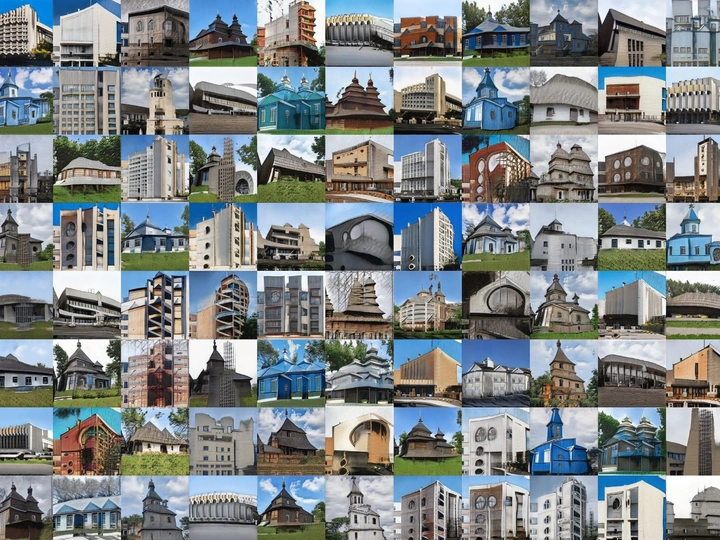
Memory in Motion is a framework rather than a solution. Using Machine Learning, it blends existing styles to create new language. Looking ahead, I envision this work as an educational tool for workshops, forums, architectural events, and so on, exploring reconstruction strategies for Ukraine as well as other locations worldwide.