Terremosse - reactivation in the post-trauma
Giulia Azzini
Davide Battel
Elisa Cordaro
Marta Gaggi
Nicole Gardumi
Maria Letizia Guido
Alessandra Ledda
Pierfrancesco Lisi
Marco Maiorana
Sofia Manieri
Maria Vittoria Moretti
Giovanni Stoppoloni
Jiaqi Wang
Terremosse is a collaborative practice of seventeen Italian young professionals working across architecture, design, urban planning and research, and currently based in different cities across Italy and Europe. Founded in 2024, it focuses on the territorial reactivation of fragile inner areas affected by natural and human-induced disasters, combining field research, collective construction and experimental forms of architectural education.
The collective operates through EASA Italia APS, a non-profit association born in 2023 as the Italian branch of the wider European Architecture Students Assembly network.
We do not work as a conventional studio. Our roles include territorial research, relations with communities and public institutions, curation, fundraising, communication, technical coordination and construction logistics. We operate in the space between local municipalities and local associations, helping them translate local needs into feasible spatial projects and strengthening connections that can continue beyond our intervention. The broader aim is to create resilient ties for sustainable development of these territories.
Our first full-scale experiment was Terremosse x Amatrice. The project gained nation-wide attention through press releases in newspapers and magazines such as artribune and Domus. A documentary shot during the event is set out to be released in the coming months.
Earthquakes, floodings, wildfires are never isolated events. They are moments when long-standing fractures become visible, exposing the complex attrition between human and natural systems. Yet these situations are often framed as extraordinary emergencies: they mobilise immediate institutional support, but their long-term consequences are rarely addressed with the same commitment. Terremosse acts on this void, exploring alternative forms of architectural practice and territorial reactivation in the current anthropoclimatic crisis.
Over the past two years, the collective has conducted research in Amatrice, where the 2016 earthquake destroyed nearly 80% of the built heritage, leaving a territory already weakened by decades of demographic decline and infrastructural neglect.
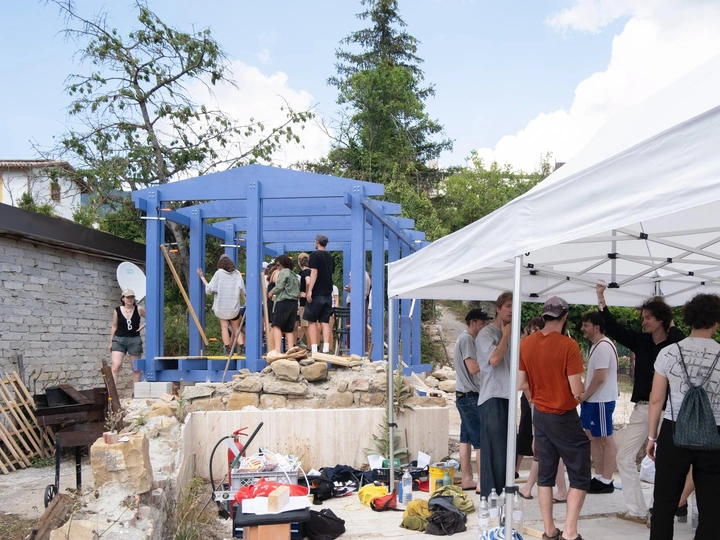
On summer 2026, Terremosse brought together 250 young architects from across Europe to collectively design and build ten small-scale public interventions: a stage, a square, a playground, a gazebo, a fire pit, a shelter, and rest areas along the lake and river. These projects became catalysts for rebuilding everyday life while addressing a recurring question: when everything has been destroyed, how can a territory become home itself?
The experience connected Amatrice with other European regions facing different but equally complex forms of vulnerability. The name Terremosse -literally “moving lands”- reflects the idea that territories are never static but continuously reshaped over time. Every place accumulates its own layers of trauma, and these fractures become the starting point for architectural inquiry.
Within the architectural discourse, the ultimate objective of Terremosse is to radically redirect architectural production towards places where architecture is actually really needed. By working within rural landscapes marked by crisis, the project proposes architectural intervention as a tool for care, solidarity, and long-term territorial resilience.