Spaces of Energy
Helmi Marie Langsepp studied sculpture and installation at the Estonian Academy of Arts before graduating in Architecture and Urban Planning. After completing her studies, she joined MAP Architects in Denmark, where she worked on architectural questions arising in extreme environments. Upon returning to Estonia, she worked on architectural, curatorial and exhibition projects at b210.
Her master’s thesis, On Not-Building: Mountain, Village and Visitors, received an honourable mention at the 2019 BAUA Awards and was presented at the Caucasus Mountain Forum. At b210, she was part of the Irish–Estonian curatorial team behind There Is a Forest in My Backyard but My House Is Built from Trees Grown Far Away, a winning curatorial proposal that later received an Architectural Association of Ireland Award.
Helmi Marie is currently the founder and architect of Lee Ell and a doctoral researcher at Tallinn University of Technology. Through Lee Ell, she develops experimental projects connecting infrastructure, material processes and environmental conditions. Recent work includes The Newborn Gallery, part of the main programme of European Capital of Culture Tartu 2024, and Melting Models, developed during the Spitsbergen Art Residency and installed across Longyearbyen. She is also the founder and editor-in-chief of Space Choreography, an independent publication exploring architecture through movement.
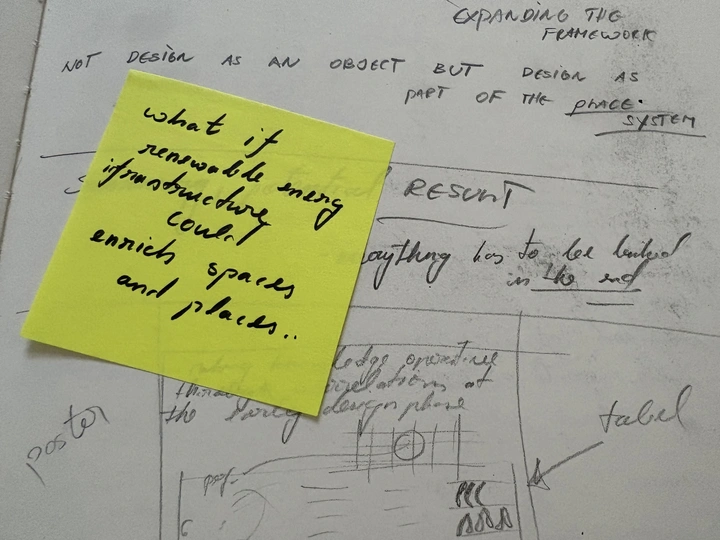
I began this project from a concern that renewable-energy infrastructure is still too often treated as a technical object to be placed into a landscape, rather than as something that can participate in shaping it. My work asks how energy transitions might also produce spatial, environmental and social value by responding to the specific conditions of a place.
Within my PhD, I have developed a relational framework for reading coastal sites through environmental processes, existing infrastructures, seasonal change, local use and experience. For LINA, I want to take this work beyond analysis and move it into a more experimental design realm. I want to use the framework as a starting point for generating speculative spatial propositions across several Baltic and other coastal contexts, extending its application beyond research methodology.
Through site visits, mapping, drawings and physical models, I will test how renewable-energy infrastructure might become an edge, shelter, threshold, public space or changing landscape structure. I am interested in forms that do not simply host technology, but emerge from the interaction between energy potential, coastal morphology, local practices and lived experience.
The project reflects how I work as an architect: by bringing technical knowledge into dialogue with material experimentation and spatial imagination. Its ambition is to show that renewable-energy infrastructure can become culturally legible and site-specific architecture, while opening a wider discussion on how the energy transition may reshape not only systems, but also the places in which they are embedded.