Unarchiving Details: Atlas of Loss
Miloš Kostić, PhD (1990), is an architect, researcher and designer based in Munich. He completed his PhD at the University of Belgrade – Faculty of Architecture, where he also worked as a teaching and research assistant from 2017 to 2022. His practice operates across architectural design, spatial research and visual media, combining professional work with independent and collaborative projects, exhibitions, lectures and interdisciplinary initiatives in Serbia and Germany.
His research focuses on architectural detail, adaptive reuse and the transformation of modernist and post-war heritage. Through drawing, photography, moving image, modelling and archival research, he examines how architectural narratives are designed, materialised, inhabited and altered over time. His current work develops media-based and design-driven methods for investigating the relationship between material change, spatial identity, collective memory and care.
His work has received recognition in architecture, education and photography, including the HERSUS Award for Innovative Educators at the University of Seville (2023), First Prize for architectural photography at the Tirana Architecture Week Forum (2019), a Special Recognition at the Belgrade Salon of Architecture (2023), and an award at the Sarajevo Photography Festival (2026). His architectural projects have also received prizes in competitions for public spaces, cultural buildings and urban landscapes. In 2024, his photographic project *Klimaparallelen*, addressing urban space and climate extremes, was exhibited in Munich.
Alongside his professional and research practice, he is a co-founder of *petougao*, a collective working across architecture, spatial practice and interdisciplinary research in Serbia.
What is the cost of giving modernist heritage a new life?
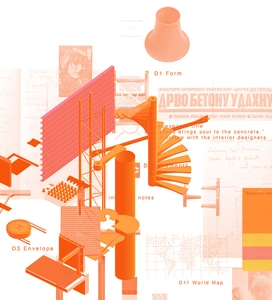
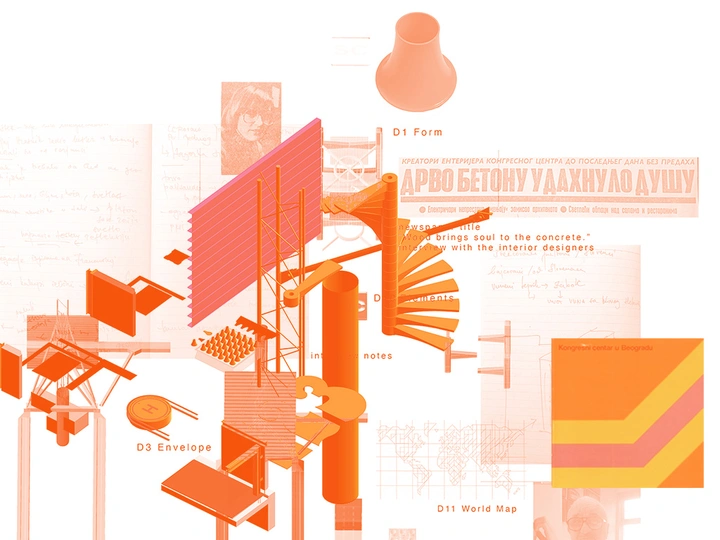
Unarchiving Details originated in my PhD research on architectural detail and developed in response to the reconstruction of the Sava Center in Belgrade. It preserves memory by reactivating archives as design media through which erased architectural knowledge can be reconstructed.
The project examines how reconstruction destabilises modernist heritage while extending its use. It frames adaptive reuse as a question of care and professional ethics: what is preserved, and what is sacrificed, when a building is given an afterlife?
My research focuses on details as points where material decisions, design intentions, labour, use and cultural meaning converge. Archival research and interviews with the design team were expanded through drawing, mapping, photography, moving image, models and reconstructed fragments. These media reactivate details where restricted documentation and access obstruct investigation.
The material was systematised through the original promotional brochure of the Sava Center. Once presenting the building as a coherent whole, the publication is cut, erased and layered to expose fractures in that image and trace what reconstruction removed, replaced or obscured.
The STEP framework (Spatial, Temporal, Epistemic and Political) reveals how details change across scales, time, knowledge and decision-making. In place of a fixed brochure, the research develops a Media-Based Atlas combining technical information on construction and material change with memories and spatial meanings.
The Atlas may take the form of an exhibition, publication and digital platform. A Community Memory Cloud can invite former employees, visitors and residents to contribute photographs, documents and stories. Details become nodes linking material transformation with lived experience and collective memory. Loss becomes a method of inquiry into how care can guide future transformations of existing buildings.