Light & Darkness as the Rhythm of Life in the City
TITIA EX
Living City Art
The Art of Light & Darkness
For Titia Ex, light & darkness are not opposites but inseparably linked. Together, they determine how we orient ourselves, what becomes visible and what remains hidden. Not only in a physical sense, but also as a space for imagination, reflection and the unknown. Darkness is not the absence of light, but a space in which other forms of perception, life and imagination arise.
Through light installations, spatial interventions and light-sensitive walks, Ex opens new ways of perceiving the world around us. Her work explores how light & dark influence our relationship with the world: what appears and disappears, what attracts our attention and what eludes the eye.
Every location has its own rhythm. Day and night, the seasons, weather conditions, human activity and ecological processes together form a constantly changing whole. Ex works with what a place already possesses: light, darkness, history, time and character. Through subtle shifts, she creates installations that deepen the experience of a place and invite a different way of looking, moving and being present.
Her practice stems from attentive looking, listening and observing. Through field research and collaboration with scientists, designers, ecologists and other disciplines, she explores how light and darkness influence our experience of the world. From this practice, she has developed light-sensitive walks: encounters with the city in which participants learn to experience the interplay between light, darkness, time and the environment anew.
It was from this practice that the role of Amsterdam’s City Light Master emerged. From this independent position, Ex brings the artist’s perspective to the social and policy-making discourse on the quality of light & dark in the city. In this way, she brings together art, research and policy in the conversation about light and darkness as essential qualities of all life.
European cities face urgent challenges: climate change, biodiversity loss, and urban densification call for new perspectives on the urban environment. Yet light is often still viewed solely as technical infrastructure, while its ecological, cultural, and sensory dimensions remain underexplored.
This proposal views light and darkness as a single, coherent rhythm in which people, nature, and the city are interconnected. Darkness is not an absence, but an active spatial condition that supports biodiversity, tranquility, orientation, and ecological balance.
Question:
How can the Light-Sensitive Walk, as an artistic research method, generate new knowledge about the significance of light and darkness for future cities?
Goal: to develop a transferable methodology in which light and darkness are recognized as interconnected spatial qualities within regenerative design.
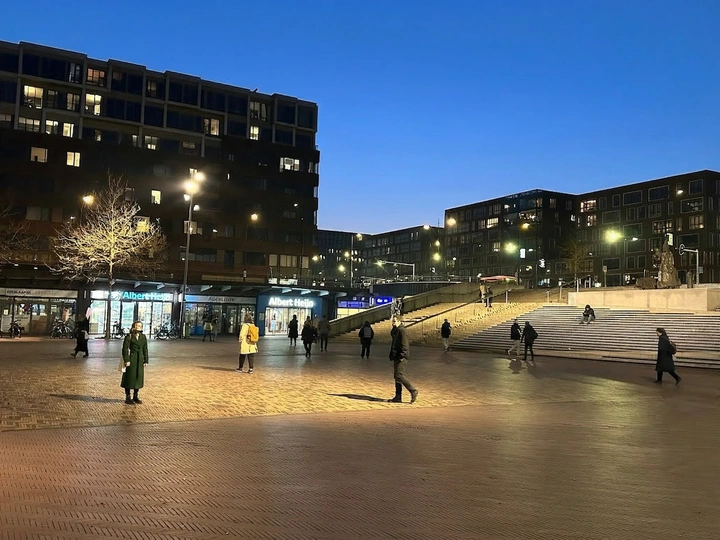
The Light-Sensitive Walk is an embodied research method: the experience of light and darkness itself serves as the instrument. Walks during the transition from day to night alter perception, orientation, and attention. The observations and reflections generate experiential knowledge that complements technical measurements.
The method was developed in collaboration with professionals and citizens and forms the basis of my role as Amsterdam’s City Light Master, where I connect artistic research with public dialogue and urban policy.
Within LINA, I aim to further develop the method into an open framework. Through collaboration across various disciplines and urban contexts, the methodology remains recognizable, while the results remain site-specific.
My ambition: to contribute to a regenerative spatial culture in which light and darkness are not technical parameters, but living qualities that guide how cities are perceived, designed, and experienced.