Tracing the Ceramic Rocket
Maxime Faure
Adam Walid Pugliese
I am an architect, filmmaker and researcher based in France and Morocco, working at the intersection of architecture, documentary practices and territorial investigations. My practice explores how places in transformation, overlooked histories and forgotten forms of knowledge can reveal alternative ways of thinking about architecture.
I have developed a research-based practice combining fieldwork, archival investigation and documentary film. Through walking, observation and conversations with inhabitants, researchers, practitioners and politics, I explore the relationships between materials, territories and communities.
I am particularly interested in marginal territories and spaces undergoing transformation, where hidden histories and alternative forms of knowledge can emerge. My work often begins with a specific place and expands through collective research, moving between architectural analysis, documentary practices and cultural investigation.
I co-directed the documentary film Les Insulaires (2021) with Maxime Faure, following the life of a social housing neighborhood in France before its demolition. The film was selected in numerous European architecture and documentary festivals, including in Venice, Copenhagen, San Sebastián and Istanbul, and received the Public Award at the Festival du Film Politique (France) and the Jury Award at the Rhodope International Documentary Film Festival (Bulgaria).
In 2026, I developed a research residency at Rue de Tanger art centre in Casablanca, focusing on the demolition of part of the historic medina. With the project "Ruina", I investigated the traces and memories left by this radical transformation, exploring how destruction can also reveal relationships between inhabitants and urban histories.
Through my work, I seek to create connections between archives and contemporary questions, between local histories and broader architectural narratives, and between research, film, exhibitions and publications.
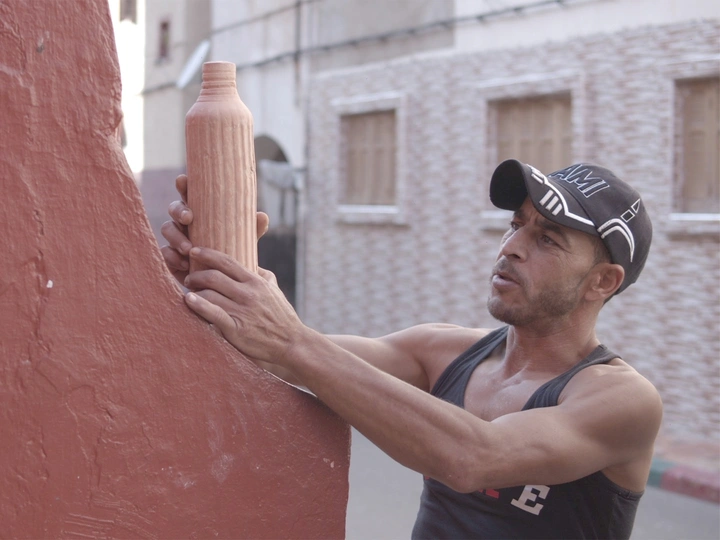
"Tracing the Ceramic Rocket" explores how forgotten forms of architectural innovation can inform contemporary practice in the context of the climate crisis. Patented by French architect Jacques Couëlle in the 1940s, the ceramic rocket system (fusée céramique) was first experimented with in colonial North Africa before circulating in Europe after 1945. Born from post-war material shortages, it used hollow fired-clay elements assembled into lightweight vaults, combining reduced material use, local resources and and passive thermal regulation.
The project began through a long-term investigation of the "Bottle Houses" of Mohammedia, Morocco, one of the last examples built with this system. Combining architectural research, documentary film, archives and fieldwork, it examines the interrupted trajectory of an architectural idea. Rather than considering the ceramic rocket as heritage to preserve, it investigates it as an interrupted architectural trajectory whose principles may become relevant again today.
The proposal shifts the focus from preservation to reactivation, as a low-carbon prototype, questioning energy-intensive construction and reconsidering local resources and adaptable principles.Developed as a response to material scarcity, this system resonates today with the need to rediscover earth-based materials and alternative forms of construction rooted in local resources and knowledge.
The research combines archives, site observation, material analysis and conversations with researchers, craftspeople and inhabitants to reveal invisible processes and relationships between materials, territories and communities.
The research will extend across Europe, tracing buildings constructed with this technique in France, Italy, Belgium, Netherlands and Portugal. By reconnecting these examples, the project seeks to understand how this forgotten system travelled, transformed and can inspire more resilient, situated and environmentally responsible futures for architecture.