Leaking Roof: A Roof Communicating with Water
io wu
io wu is a Chinese material researcher, artist and spatial practitioner based in Eindhoven, the Netherlands. Her work investigates how materials mediate relationships between water, architecture, labour and cultural memory. Working through ceramics, installation, field research and publishing, she combines material experimentation with situated stories and lived experience.
She graduated cum laude in Fine Art from Design Academy Eindhoven. Her practice moves between intimate material tests and spatial propositions, often beginning with a malfunction, an overlooked material or an inherited story.
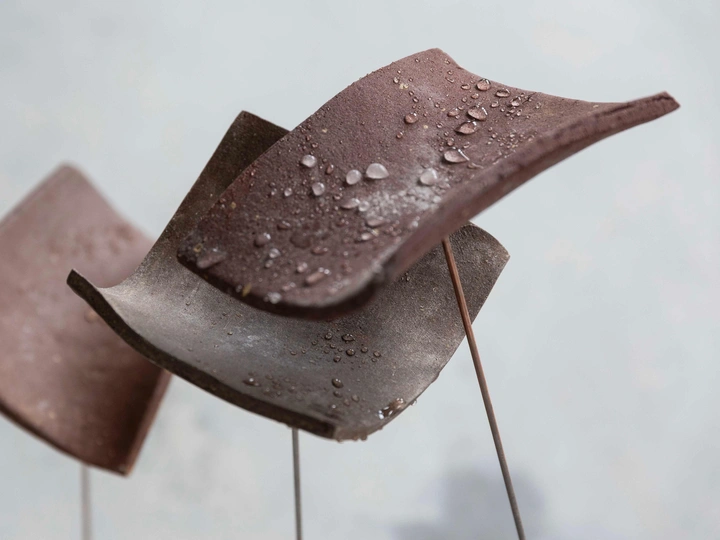
Her ongoing project Leaking Roof explores roof leakage as a form of communication between architecture, inhabitants and environmental forces. Using Dutch clay and sediment originating from former seabed, she makes ceramic roof tiles and studies porosity, cracking and unpredictable water movement. Rather than seeking full control, the project examines how failure, seepage and material instability can reveal the changing condition of a building.
Her earlier water-based research includes Follow the Flow and Let It Go, two artist books developed through fieldwork in Nepal, China and the Netherlands. These projects trace how water shapes daily life, movement, memory and cultural understanding. Her experience living and working aboard a sailing boat further informed her interest in water as both environment and spatial condition.
Her work has been presented through exhibitions and research contexts in the Netherlands and internationally. She was selected for a Stimuleringsfonds Creative Industries NL residency at Jatiwangi art Factory, where she is developing research into roof-tile production, local clay and community knowledge. Across her practice, she explores how traditional material knowledge can enter into dialogue with contemporary architecture.
Architecture usually treats leakage as failure: roofs are expected to seal, separate and protect. Leaking Roof asks what might change if water were understood not only as a threat, but also as a medium through which architecture communicates—revealing material conditions, weather and the relationship between a building and its inhabitants.
The project began with my experience of living beneath a leaking roof. It is also informed by the Chinese tradition of si shui gui tang, in which roofs guide rainwater into a central courtyard and domestic life. In my hometown, reused tiles once moved between neighbouring houses and generations. Rather than offering solutions for the Netherlands, these practices suggest another understanding of roofs as systems of circulation, adaptation and shared care.
The research focuses on Nagele, a village built on land reclaimed from the former Zuiderzee and conceived as a progressive model of modern housing and collective life. Its relationship to water, land-making and modernist architecture raises a question: after turning water into land, how might architecture allow water to return in visible and meaningful ways?
I investigate this through ceramic roof-tile tests made from Noordoostpolder sediment. The clay contains shell fragments—evidence that the land was once seabed. By varying firing temperature, thickness and surface treatment, I study porosity, cracking and unpredictable water movement. Rather than pursuing complete waterproofing, the project explores how partial permeability might make rainfall and material change perceptible.
The next phase will combine material research, site observation and conversations with residents and local specialists. Its form will emerge from this process. Leaking Roof asks whether leakage might create a more responsive relationship between water, architecture and inhabited space.
CAN LEAKAGE RECONNECT ARCHITECTURE WITH NATURE?