Gaia Communication System (GCS)
Yuji Masuda
INXECTS is a research-driven design and architecture laboratory operating between Scandinavia and Japan. The team combines architecture, environmental sensing, prototyping, and technological development to explore how design can create new relationships between humans, technology, and non-human life.
The proposal is developed by architect Pavels Hedström and engineer Yuji Masuda.
Pavels Hedström is a Swedish architect and founder of INXECTS. His work investigates how architecture can function as an interface between humans, technology, and ecosystems through speculative design, environmental infrastructures, wearable systems, and experimental spatial practice. He holds a Master's degree in Architecture and Extreme Environments from the Royal Danish Academy and has exhibited internationally, including at the Venice Architecture Biennale 2025. His work has been published by The New Yorker, Dezeen, Designboom, Financial Times, and Dagens Nyheter.
Yuji Masuda is an engineer and technological developer with extensive experience in electronics, sensing systems, hardware development, and digital interfaces. He leads the technical development of the Gaia Communication Systems platform, including environmental sensing hardware, wireless communication, data systems, and user interfaces.
Together, the team combines architectural thinking and engineering development to create ecological communication systems that translate environmental conditions into sensory experiences. Their work operates across scales, from wearable devices and portable environmental laboratories to architectural installations and larger ecological infrastructures.
Gaia Communication Systems (GCS) is a research and design platform exploring how architecture might function as an interface between humans and ecosystems.
Contemporary environmental technologies communicate primarily through screens, graphs, and notifications. While useful, these systems maintain a distance between people and the conditions they inhabit. GCS investigates an alternative: translating ecological processes directly into sensory experience.
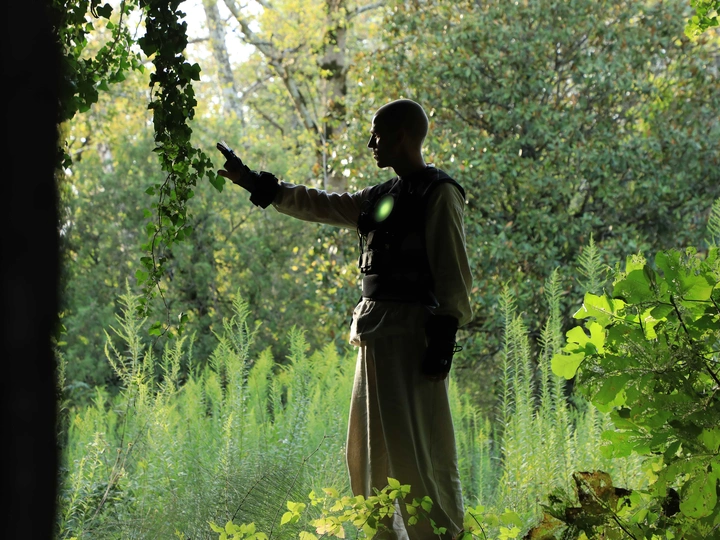
The project began as a wearable prototype equipped with environmental sensors - measuring air quality, humidity, temperature, soil conditions, water quality, plant health, and biological activity - and converting those signals into haptic feedback and light cues. The intention is not to optimize efficiency or increase data collection, but to explore whether environmental awareness can become embodied rather than abstract.
Since then, GCS has evolved into a broader architectural framework with potential of operating across multiple scales: from wearable devices and portable environmental laboratories to spatial installations, public infrastructures, and architectural environments. Each component functions as part of a larger ecosystem of interfaces designed to strengthen relationships between humans and non-human life.
Drawing from architecture, environmental sensing, interaction design, ecology, and speculative design, the project asks how built environments might move beyond shelter to become active participants in ecological communication.
Rather than a finished solution, GCS functions as an evolving, open framework adaptable to different environmental, social, and cultural contexts. Future development focuses on modular systems that enable communities, institutions, and researchers to develop their own forms of ecological communication - contributing to new modes of environmental literacy, stewardship, and coexistence in a period defined by ecological transformation.