Fuoriscala: Theatre Through Adaptive Reuse
Daria Ribera
I am an Italian architect who graduated from Politecnico di Milano in 2017. Since the beginning of my professional journey, my passion for architecture and my curiosity towards different cultural contexts have driven me to live and work in diverse environments around the world.
My experiences in Italy, France, and the United States have allowed me to explore different approaches to design, construction, and architectural practice. Working within these different realities has strengthened my belief that architecture is a continuous dialogue between culture, technology, materials, and the specific conditions of each place.
My background in architectural construction has shaped my interest in the relationship between conceptual ideas and their physical realization. I am particularly interested in how construction systems can become an integral part of the architectural language, influencing the way spaces are experienced and perceived.
I am currently based in Ireland, where I work for an American architectural practice on multidisciplinary projects. This international environment allows me to combine different methodologies and perspectives, developing a design approach that integrates creativity, technical knowledge, and collaboration.
Throughout my career, I have been motivated by the opportunity to understand how architecture responds to different contexts and how each project can become a meaningful connection between people, places, and materials.
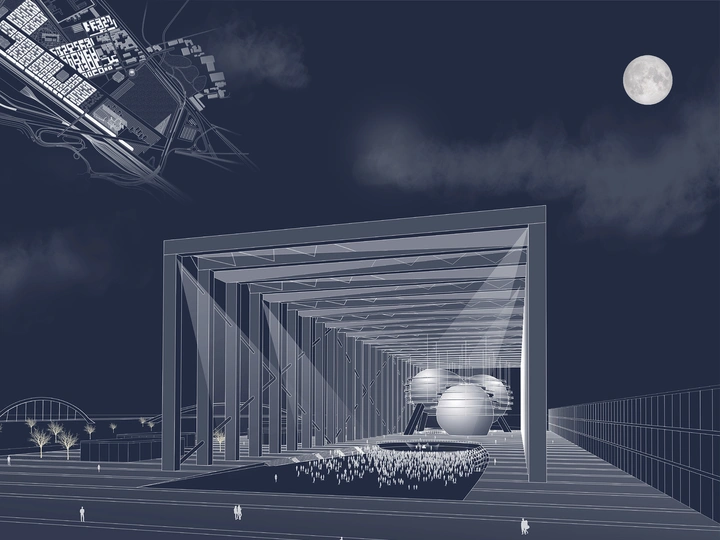
Fuoriscala is an experimental theatre for Teatro alla Scala conceived for Milan's former Expo site, a place undergoing continuous transformation. Instead of treating the site as a blank slate, the project embraces adaptive reuse, preserving and reinterpreting existing infrastructure as the foundation for a new cultural landscape.
At the heart of the proposal is the former Open Air Theatre. Rather than being demolished, it is transformed into a public square and the fourth performance venue of the theatre complex. This gesture preserves the site's identity while reconnecting it with the surrounding urban fabric, allowing culture and everyday public life to coexist within the same civic space.
The project is driven by a simple question: what is a theatre? A theatre is a place of wonder, where the unexpected becomes possible. This idea inspired the concept of the building as a magic box. Its outer shell is a pure and restrained volume, while inside it reveals three suspended performance halls—floating architectural objects that surprise visitors and immerse them in the theatrical experience. The contrast between the simplicity of the envelope and the extraordinary interior reflects the essence of theatre itself: a place where imagination transforms reality.
Each performance hall is designed for a different form of theatrical production, while elevated walkways connect them into a single architectural organism. The preserved outdoor theatre extends this experience into the public realm, dissolving the boundary between performance and the city.
By transforming rather than replacing what already exists, Fuoriscala proposes an alternative model of urban regeneration. It preserves memory, reduces material waste and demonstrates how architecture can create new cultural value through continuity, adaptation and care. More than a theatre, Fuoriscala is conceived as a civic stage where architecture, performance and public life become one.