Kaputt - a path is formed by walking.
Paulene Kaiser
We both graduated from the Masters program 'Architecture and planning beyond sustainability' this year where we met and started our collaboration. Emma is born and raised in Gothenburg, Paulene in Berlin. The ecological crisis with its ever-accelerating pace and unceasing drive for newly produced keeps us both looking for a different way of working, slower, within the planetary boundaries and the framework of degrowth.
We both have a Bachelor in Architecture from our home cities and have worked two years in architecture offices in between that degree and the start of the two years Master at Chalmers. Emma already had experiences from that job with circular architecture and reusing materials. Paulene had worked with existing building mostly under heritage protection with transformation and restoration.
In a course during our Master called 'Dare to build' we met during a very practical process, where we were assigned to hunt for materials that we reused in this hands-on self building course. We met a lot of people and made connections to a bubble of grown ups that were actually working exactly in this field of reusing and building their own projects. We realised how much you have to be on site and present for this kind of work. And how important it is to speak to people, learn from them and exchange knowledge. We continued with this and wrote our Master Thesis 'Kaputt' together where we explored another way of situating ourselves in the building bubble.
We were successful with the project, it was a lot of fun and we learned so much! We had great conversations about it with all kinds of different people, got invited to speak at the Design Museum in Gothenburg about it and write in a publication called 'Paradigme' for the Oslo Architecture Triennale about our approach of neglected and existing architecture.
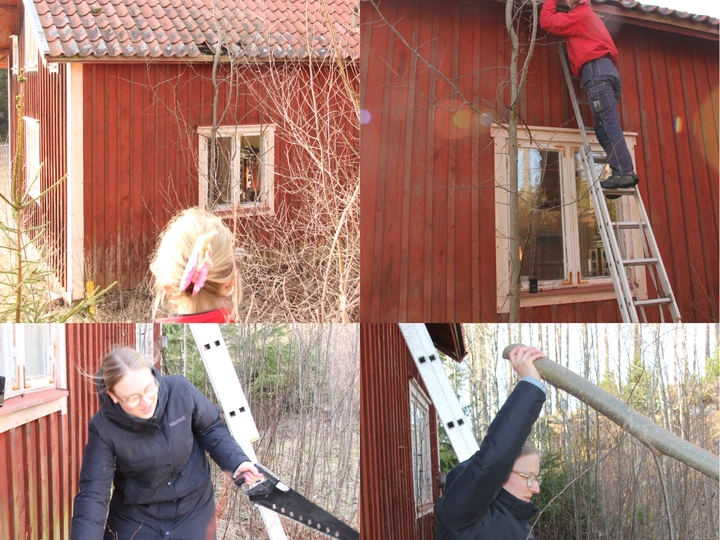
The project is an embodied architectural exploration, a method-acting routine where we surrender to a neglected building. We live with it, learn from it, and care for it. Through this hands-on method, we seek to understand architecture not as an act of creation, but as a practice of maintenance, presence, and care in times of this ecological crisis we are in.
Our aim is to worry, to care, to maintain. Through focusing on and valuing what already exists, we find meaning in the act of tending to the overlooked and “hopeless” structures that lie beyond market logic.
By living in and with a building: listening, mapping, drawing, connecting and repairing, we create a routine of slowness, where architectural knowledge is learned through the body, through trying, asking and time.
The process suggests how architects can adopt a practice in tune with the ecological limits of our planet and a practice that is seeing value beyond the logic of economic growth. The project aims to transform our understanding of the architectural practice, exploring how attention, care, and maintenance can become tools for a more meaningful, and situated way of working. The process is inherently political.
Interviews with practitioners working with tangential questions were used as a tool to gain insights on how to formulate the practice. Study visits were used to get practical knowledge on building methods, materials and maintenance.
Looking forward, we see this work as the beginning of a broader architectural practice that can be applied to other neglected sites. Through living in the house, we were able to map and research the interventions crucial to keep it from further decay. A selection of interventions were made. The thesis shows the knowledge gathered through being, doing and living in the house. We formulated a practice with the creation of a sense of home at its core. Over time, the value of the house changed noticeably for us. The path was formed by walking.