Housing Abanian Culture
Her work focuses on public architecture, cultural infrastructures, renovation, and the relationship between built heritage, collective memory, and contemporary social needs. Through design, research, exhibitions, and teaching, she explores how architecture can function as a cultural and social framework.
She is currently a PhD researcher at the Faculty of Architecture and Design, Slovak University of Technology in Bratislava, where her doctoral research “Regional variant modernity? Houses of Culture in 20th Century Albania” examines Houses of Culture as new typologies within the broader European context of 20th-century cultural infrastructures. The research is further developed through international research mobilities, including a research stay at the École Nationale Supérieure d’Architecture et de Paysage de Lille, May 2026 and at the University of Basel, October-December 2026.
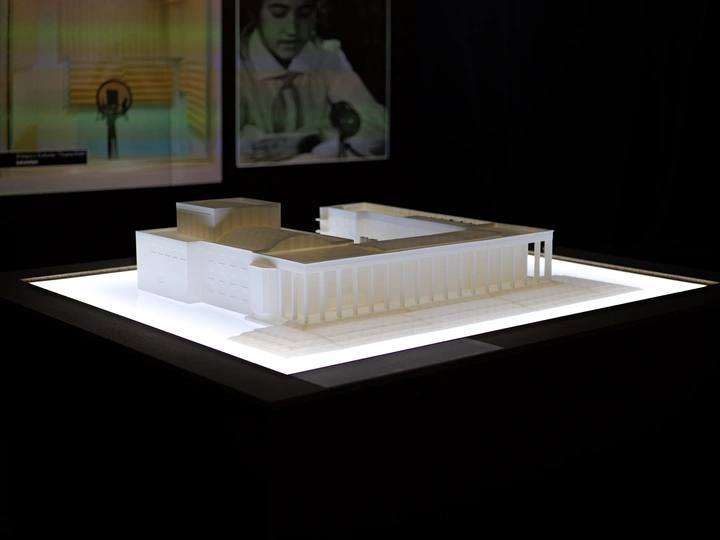
Her research project “Housing Albanian Culture” developed into an exhibition presented at the National Theatre of Opera and Ballet in Tirana in 2025. The exhibition explored the history, architecture, and contemporary condition of Houses of Culture in Albania through archival documents, drawings, photographs, and field research. Supported by the Ministry of Culture of Albania and the Extraordinary Excellence Grant of the Slovak University of Technology, the project used exhibition-making as a method of architectural research and a platform for public discussion on modern architectural heritage.
Alongside her academic work, she has professional experience in architectural design, focusing on public projects, architectural competitions, and renovation processes. Her work has been recognized through awarded competition projects, reflecting her interest in architecture that responds to historical context, social values, and contemporary challenges.
After the Second World War, across both Western and Eastern Europe, a vast network of Houses of Culture, cultural centres was built with the ambition of decentralising culture and making education, artistic production and collective life accessible to broader sections of society. These spaces became the backbone of cultural infrastructure, extending cultural participation beyond major urban centres and embedding cultural production into everyday life. Albania followed a similar trajectory, developing a nationwide network of Houses of Culture that transformed villages, towns and cities into spaces of collective learning, performance and social exchange.
Initiated through archival research, fieldwork and the exhibition Housing Albanian Culture, the project has documented more than 100 cultural objects and 50 Houses of Culture across Albania, bringing together architectural drawings, photographs, archival documents, oral histories and spatial analysis.
The project proposes to move from documentation towards cultural production by transforming this national archive into a European common space for exchange and public discussion. It asks how the legacy of twentieth-century cultural infrastructures can inform contemporary debates on access to culture, civic life and the reactivation of existing buildings.
By placing Albania’s experience within a wider European context, Housing Albanian Culture reveals shared histories between different political and geographical contexts, while also questioning how these spaces have been transformed after the political, economic and social changes of the late twentieth century. Rather than treating archives as static repositories of the past, the project approaches them as active tools for generating new narratives, collaborations and forms of cultural engagement.
Through mapping, exhibitions, publications and collaborative formats, the project aims to develop a dialogue of European Houses of Culture.