Building with reed plants for community creation.
The German product and spatial designer is creating holistic solutions and concepts for environmental and social challenges through sustainable practices, innovative materiality, and community creation.
Her motto: “Everything is connected to everything.” When we understand that everything we do has an impact, we can create for other-than-human beings.
Michelle has developed a broad skill set, from objects to spaces to whole exhibition concepts and event organization, combining product design, material research, and architecture in her practice.
She graduated in 2026 from Konstfack University of Arts, Craft and Design with a Master's in Design Ecologies, after working for several years in an interior architecture studio for exhibition design.
She is a member of the non-profit collective Operation Himmelblick in Berlin, which is transforming vacant parking lots into community hubs.
2026, she founded her design studio “mhei” for sustainability consulting and design concepts for public space and the culture and educational sector.
She has hosted workshops for example for designing with Mycelium and "City-Making".
How reed harvesting can save the Baltic Sea and foster a social climate.
Reed absorbs excess nutrients like phosphorus and nitrogen that cause harmful eutrophication in one of the world’s most polluted seas. When harvested correctly, you can relieve the sea of overnutrition, and the invasively growing plant can become a versatile material for building, designing & gardening.
“The Reed Cycle” project explores a circular business model that tackles social, economic and environmental issues for small island communities in the Baltic Sea.
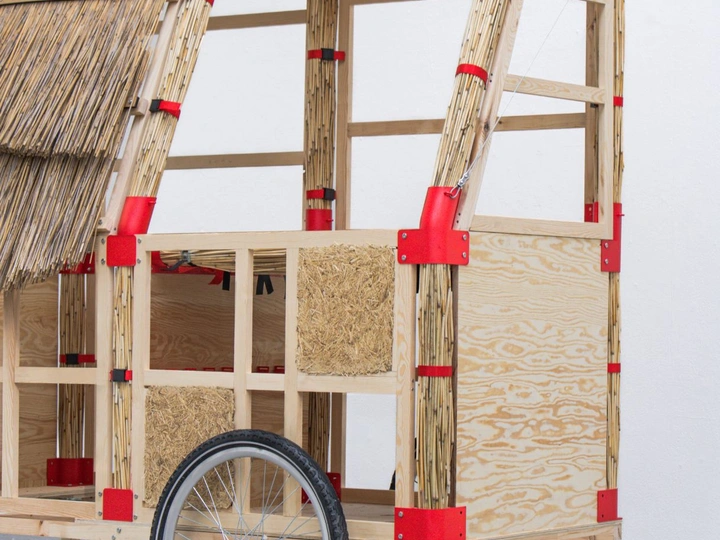
The modular design utilizes raw reed stems as structural components, newly developed reed boards, bonded with 100% biodegradable glue from the island’s waste streams, and traditional thatching for waterproofing.
One outcome is a community market booth for local vendors to initiate gathering spaces like markets and festivals. Designed for easy assembly, the system fosters civic engagement and community resilience.
The project supports hyper-local resourcing and shifting awareness to alternative building materials.
After the materials' life cycle, it can be broken down and replace peat in the community garden soils. This prevents harmful CO2 emissions from peat extraction. The nutrients from the ocean absorbed into the reeds support soil fertility and make a perfect replacement for peat.
I worked in close collaboration with Utö Initiativ, an NGO on Utö island in the Stockholm Archipelago that is facing an aging population and has no job opportunities in the off-season. The Initiativ built wetlands around the islands that have a lot of unutilized reed - the starting point for creating a sustainable business model around it.
I hope to develop the prototype further and host workshops to improve the modularity and explore what other public infrastructures can originate from reed, while keeping the needed skill threshold as low as possible.
Also, proper scientific testing of the materials' static properties would be great.