Ecoredaction: reading the landscape as an archive
I am a researcher and urban planner from Ukraine. During my studies, I gained practical experience as an architect and taught a short pre-entry creative writing & architecture philosophy course at the Kharkiv School of Architecture. Since 2022, I have been a member of Ro3kvit: Urban Coalition for Ukraine. Through this NGO, I participated in developing the spatial recovery strategy for Mariupol (2022–2024) and led a participatory memory mapping project for the Hirske Hromada in the Luhansk region (2024). Throughout my professional practice, I have actively organized and facilitated numerous community engagement and co-design events.
Currently, I am an Erasmus Mundus scholar in the Redesigning Post-Industrial Cities program. I am completing my master's thesis, War Ecologies of Water: Multi-Species Justice and Groundwater Contamination in the Temporarily Occupied Regions of Ukraine.
My written work includes the essay "Home as a Territory," published in the book Housing in Times of Crisis (by Spolka and the NeverNever 2023 summer school). The research on Urbicide, I have co-authored, is currently under peer review in the Journal of Urban Affairs.
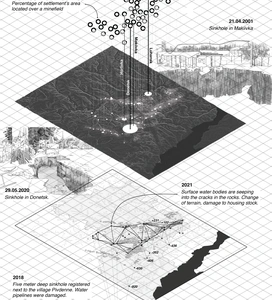
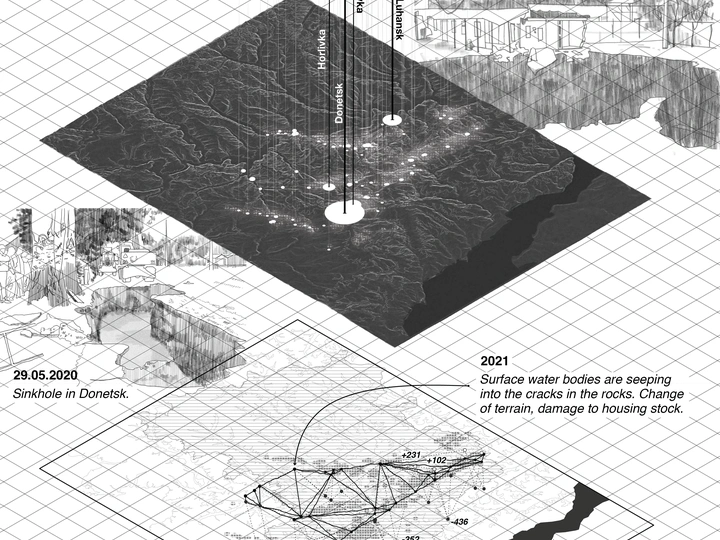
Following Yildirim's (2023:29) concept of eco-redaction, the project utilizes the landscape as botha subject and an analytical medium of discursive disruption, where “ecological resurgence pushes back against the logocentric hold of the archives” (Yildirim, 2023:33), revealing the contestations and inconsistencies within the histories of the socio-technical systems of Ukraine. The projects seeks to narrate the contested histories of post-extractivist landscapes of Ukraine thorugh the means of geospatial forensics and counter-mapping, wehere the spatial data is situated within the physical body of the landscape and layered against a heterogeneous visual archive comprising satellite imagery, archival photography, technical diagrams, and works of art. Juxtaposing the discourses recovered from textual sources against the physical evidence of their spatialization is thus instrumental in deconstructing dominant historiographies. It allows for a clear distinction between the conceived, perceived and lived colonized spaces. Utilizing a mixed-media approach, it employs a rhizomatic form of storytelling designed to retune the viewer’s experience for a more empathetic, non-extractive engagement with the subject, while also giving the agency to the non-human "vibrant matters" (Bennett) of the land. The projects seeks to expand the knowledge on the longue-duree histories of Ukrainian territories affected by extractivism and resourcification, that still reverberate today.