Building Emptiness: Protocols of De-Growth
Joshua Guiness is an architect and researcher working at the intersection of architecture and law. His practice begins from a single premise: spatial arrangements don't merely reflect social and ecological conditions — they actively produce them. Joshua develops protocols, scenarios, and strategies for territories under planetary pressure.
Based between Zurich and Berlin, he works across three platforms.
E-FX (Edge Effects) is an independent research-design practice that drafts protocols — spatial-juridical instruments for composing space across legal, ecological, and material registers. It works through three intersecting tools: diagrams that map how material configurations exercise authority, protocols that propose alternative territorial arrangements, and scenarios that make speculative futures legible. Recent work centres on Berlin's edge territories, Mediterranean coastal regimes, and the planetary garden as a political-ecological figure.
Architecture Land Initiative (ALIN), which he co-leads, is a collective developing trans-scalar approaches to spatial planning that integrate the legal, economic, and ecological dimensions of land, working primarily in Swiss contexts on public space, contributive design processes, and ecological transformation.
VOLUPTAS at ETH Zurich, where he is a lecturer, is a Master's studio in architectural design that develops projects through speculative scenarios and worldbuilding; he teaches seminars exploring experimental design and architectural worldbuilding.
Joshua holds a Master's in Architecture from ETH Zurich and a postgraduate degree from the New Centre for Research and Practice. In 2026 he was a fellow at Organismo: Art in Applied Critical Ecologies, facilitated by TBA21 in Madrid. His writing has appeared in trans, Scroope, and Situation Magazine, among others, and he is developing Protocols of Another Berlin, a book of interviews and scenarios on the city's contested edges, forthcoming with Distanz Verlag.
De-growth has an economics and an ethics, but barely a space. What does a city that stops growing look like? Building Emptiness is a research project that pairs a documentary atlas of legally suspended grounds with drafted spatial-juridical protocols; its first cycle, four Berlin territories, is complete, and the method is now built to travel.
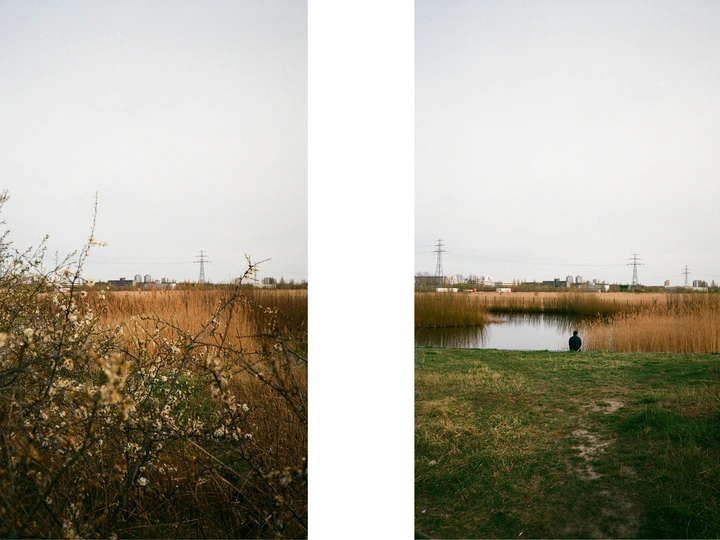
Berlin is the laboratory. A century of ruptures seamed it with strips and enclaves where suspended or archaic legal conditions kept construction out; absent building, unplanned ecological and social richness took hold. These are Europe's inadvertent de-growth territories: land removed from the growth cycle not by design but by law's hesitation — proof that withdrawal yields abundance, not lack.
The four Berlin cases: no-man's-lands where jurisdictions fail to meet (NIEMANDSLAND); the shared border utility between parcels (GRENZEINRICHTUNG); commercial yards of rich programmatic entanglement (GEMENGELAGE); forest under a bann older than the state administering it (BANNFORST). Each moves through vignette, archive, photography, diagram, rule-set, photomontage, narration — ending in a protocol: a spatial-juridical instrument that makes the accident repeatable. The protocols are de-growth made operative in law: they withdraw building rights rather than grant them, de-program rather than optimize, entangle ownership rather than clear it. They treat emptiness as something a city can deliberately build — and law as its material.
Every European city has its spatio-legal edges — expired concessions, contested coastlines, servitudes, dormant commons — and the method travels: new edge-studies in host cities, exhibitions of rule-sets and photomontages, a publication treating the protocol as a genre of architectural writing. Each extends an atlas of Europe's suspended grounds — an argument that the answer to the environmental crisis is not more refined objects, but more refined rules for less.