"Blue as Environmental Behaviour"
I am Sonia J., a Portuguese visual artist based in Serra da Estrela. Before establishing my artistic practice in 2024, I spent nearly three decades founding and leading technology companies, managing multidisciplinary teams and teaching at university. This experience now informs how I structure research, collaborations and site-responsive projects.
My practice operates at the intersection of large-scale painting, material research and spatial experience. I work with raw cotton, acrylic media, mineral pigments, sand and sediments collected from rivers and lagoons in Serra da Estrela. Through absorption, gravity and erosion-like processes, I investigate how surfaces respond to architecture, daylight, viewing distance and human movement.
My work has been presented in Venice, Milan, Rome, Barcelona and New York, and placed in private collections and residential, hospitality and healthcare environments across Europe. My interests include reversible spatial interventions, existing architecture, local material mapping and collaboration between art, architecture and environmental research. Within LINA, I would contribute as an artist, researcher, workshop leader and experienced public speaker.
"Blue as Environmental Behaviour" began with a question arising from my practice in Serra da Estrela, Portugal: can an existing architectural space be transformed through matter, light and scale, without permanent construction or material intervention?
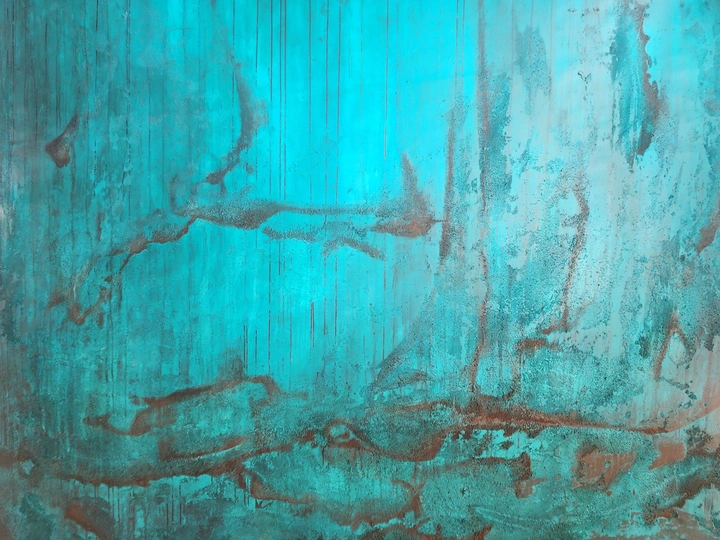
The proposal investigates large-scale painted surfaces as spatial instruments rather than autonomous objects. I work with raw cotton, acrylic media, mineral pigments, sand and sediments collected from the Seia River and lagoons. Subjected to gravity, absorption and erosion-like processes, these surfaces respond to daylight, viewing distance and human movement. Blue therefore operates not as a fixed colour, but as an environmental behaviour.
The research has developed through suspended and stretched works, material studies and installations in residential, hospitality, healthcare and exhibition settings. From a distance, each work establishes an atmospheric field; at close range, sediments, incisions and variations in absorption reveal its construction. Perception changes as light and people move through the space, without permanently altering the architecture.
The proposal addresses environmental responsibility through material restraint, adaptation and attention to place. It does not claim that painting is inherently sustainable. Instead, it tests how reversible interventions can modify existing interiors using limited material means. Sediments are used as physical evidence of erosion, water systems and territorial change, not as decorative references to nature.
I want to develop this inquiry with architects, spatial practitioners and environmental researchers through site-responsive installations, studies under different light conditions, local material mapping and public workshops. The aim is to establish a transferable method for testing how materially restrained artistic interventions can strengthen environmental awareness and produce meaningful spatial change.