The Militarization of Landscape
Yevheniia Berchul is an architect, urban designer, and researcher based in Berlin. She is a Research Associate at SpACE Lab (Spatial Analytics and Crossdisciplinary Experimentation Lab) and a PhD candidate at the ISU—Institute for Sustainable Urbanism, Technische Universität Braunschweig, directed by Vanessa Miriam Carlow. Her research explores how occupation and the militarisation of landscapes shape urban planning as a tool of territorial control in conflict contexts.
She was invited as a speaker at the UIA World Congress of Architects 2026 in Barcelona, Spain, where she gave a presentation in the panel titled "Territories of Violence: Memory, Infrastructure, and Spatial Justice." In 2026, she also authored two essays published in books exploring landscape and conflict in the Crimea and Black Sea region. The first, "Between Orchards and Citadels: The Dual Landscape of Crimea," in the book The Shape of Recovery. The second, "Between Identity, Conflict, and Geology: Crimea and the Black Sea Basin as a Contested Landscape," was co-authored with Yevheniia Berchul, Nabi Agzamov, and Vanessa Miriam Carlow, and published in the book Landscape of Defence. Her work engages with themes of spatial justice, memory, and territorial conflict, with a particular focus on contested landscapes in the Crimean and Black Sea region.
Today, militarization is reshaping landscapes far beyond the territories of active hostilities. Beyond the direct destruction of war, states are rapidly expanding military infrastructure, borders, defense production, and reorganizing land for training, logistics, and strategic protection. This accelerating militarization places growing pressure on economies, communities, and natural environments. Across Europe, it is producing a new spatial reality in both urban and rural areas where military priorities increasingly shape land use. Yet these transformations are still largely treated as technical or strategic necessities, rather than contentious processes with long-term social and environmental consequences.
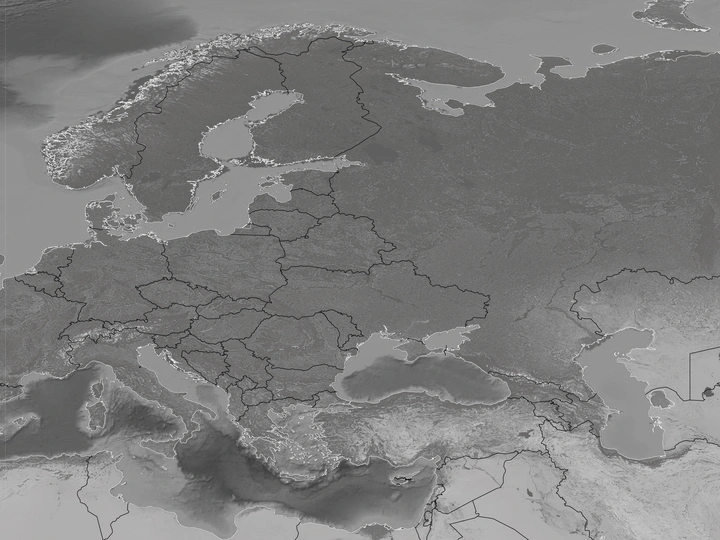
This project focuses on the militarization of the Black Sea and Crimea, examining how militarization becomes embedded in landscape and reshapes the relationship between territory, society, and space. The region has been occupied and heavily militarized by Russia, particularly since the 2022 invasion of Ukraine — but its significance extends beyond the immediate conflict. The Black Sea is ecologically interlinked with the Mediterranean, so militarization here carries consequences for a much wider marine and coastal system. Crimea, almost entirely surrounded by the Black Sea, functions as a strategic instrument within this militarized geography.
The project is a work in progress, developed through essays, spatial mapping, remote sensing, and hydrological and ecological mapping alongside other GIS techniques. Focusing on the Black Sea and Crimea, the research examines different forms of militarized landscape against the natural processes and ecological systems that continue to shape environmental conditions beyond military control, state defense, and borders.
As an ongoing body of research, the project's aim lies in the framework itself — a way of reading militarized landscapes through both territorial control and ecological process.