Greenhouses of Attention
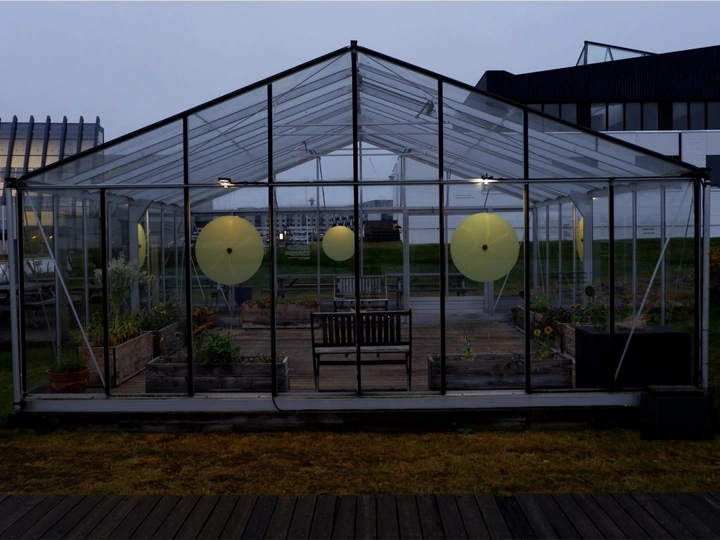
I am an interdisciplinary artist and spatial practitioner based in Reykjavík, whose practice investigates interspecies relations through participatory fieldwork and the design of spatial media dispositifs in specific ecosystems. My work began with Non-Flowers for a Hoverfly, an art–science collaboration with scientists at the National Centre for Biological Sciences (NCBS) in Bangalore, building a multisensory virtual environment for a pollinating insect using 3D modelling, VR, sensing technologies and synthetic scentmaking. Double Capture, shown at Sequences Real Time Art Festival (Reykjavík, 2025), let audiences physically feel pollination vibrations inside a greenhouse using transducers and vibrating surfaces. I have been supported in Iceland by the Intelligent Instruments Lab, and previously developed the project Species Without Spaces during a residency at the Laboratoire Modulaire, ESAM Caen, working with scientists, ecologists and local interest groups.
Botanical gardens were built to stage plants for human observation. This fellowship proposes them instead as rehearsal spaces for more-than-human ecologies: sites where architecture can be redesigned to support sensory exchange between humans, plants and pollinators. It builds on three strands of my practice: Double Capture (Sequences Festival, Reykjavík 2025), which let visitors feel pollination vibrations inside a greenhouse via transducers; Vegetal Media Fieldtrips, a method for guiding groups to sense plant environments rather than observe them; and Eco Organium, my ongoing research into plant-sensing infrastructures.
I propose a series of collective fieldtrips into botanical gardens connected to LINA partners: first at Ljubljana Botanical Garden alongside Parameter Festival, testing vibratory and scent dispositifs with festival audiences; a second at a garden hosted by another LINA Member, to compare climates and collections; and a third co-organised with fellow Fellows from adjacent fields, cross-pollinating methods. Each combines a guided walk, a sensory ritual, dispositif testing and reflective group discussion, fully documented for a closing publication.
That publication will translate the fieldtrips into concrete design directions for future greenhouses — on vibration-conductive materials, scent architecture, pollinator-informed light and glazing, and spatial choreography for gathering around plants without merely spectating them — framed by Haraway, Stengers, Hustak/Myers and Yuk Hui.
The proposal scales easily: from one deep fieldtrip and a short zine, to a full network of sites and a printed toolkit, adaptable to whichever LINA Members and Fellows want to collaborate.