Chimeric Cities - Global Implants
Tim Schwander
Tim Schwander (born 1998) is an architect based in Bern, working between design practice, applied research and writing on the transformation of public space under tourism and capital.
Raised in Zermatt, his interest in touristic urbanism is biographical before it is academic. Before his academic path he worked several years in design and project management at atelier a und b in Bern (2020-2024). He holds a Bachelor of Arts in Architecture from Lucerne University of Applied Sciences and Arts (HSLU, 2025) and is completing his Master's at the same institution, where he also works as a research assistant, contributing to teaching and to the research lab CCTP.
He currently practises as a design architect at GWJ Architektur in Bern, where he is also responsible for communication and public relations, and in 2025 co-founded studio z und m, an emerging practice based in Bern. He sits on the board of SIA Sektion Bern and was, 2022-2025, part of the organising committee of Open House Bern, responsible for marketing and project development of its first edition.
His writing has appeared in the Swiss architecture magazines Lila Strauss and Karton, and as a freelance contributor to Werk, Bauen + Wohnen, following an internship in the online editorial team at Espazium. He is currently developing "Globale Implantate," a field research on alpine touristic settlements in Zermatt and Grindelwald.
For Schwander, architecture is more than building: a continuous process of thinking, negotiating and deliberate design that requires critical distance, a clear position and exchange across disciplines. His work moves between the drawn project, the researched argument and the public text - convinced that architecture's role in current environmental and social crises depends on making its questions legible outside the discipline itself.
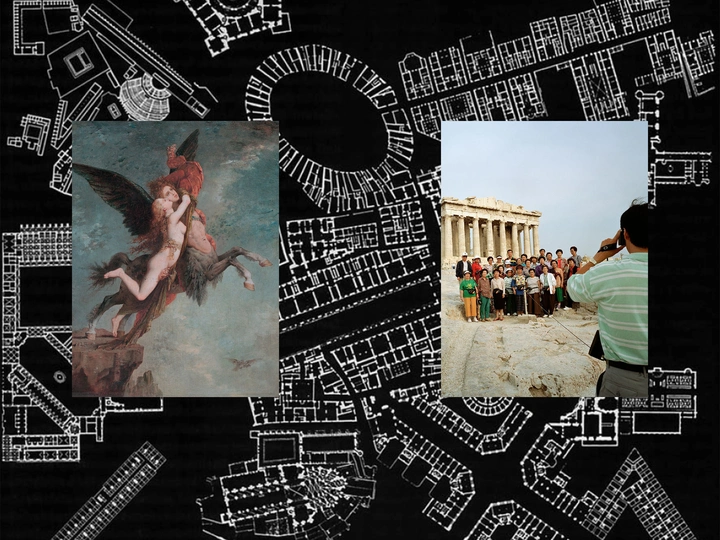
Chimeric Cities - Global Implants is a research-by-design method addressing how public space in tourist cities can be reclaimed from its reduction to stage, image and economically exploitable surface.
The project originates in a study of three Swiss cities - Lucerne, Bern and Zermatt - read through Rem Koolhaas' Generic City and Jaap Bakema's Total Space. Where the Generic City describes identity flattened into a marketable image (Lucerne risks becoming a Hyper-Lucerne, a caricature sustained by expectation rather than everyday use), Bakema's Total Space insists on a relational bond between human, city, society and environment. Tourism does not cause this condition; it accelerates it, exposing what is spatially possible but fiscally and programmatically avoided.
The design method responds with the chimera: a hybrid creature composed of unrelated parts, here reinterpreted as a spatial strategy. Classical typologies of public space - loggia, galleria, portico, arcade, orto botanico - are inscribed as implants into residual ground: leftover space that remains after subtracting building footprints, planning secondariness, opportunistic transit. Not filling these spaces, but permeating them, so overlapping, incomplete and ambiguous uses can coexist and shift over time.
Lucerne's Schweizerhofquai served as the first prototype: a residual strip beside the Hotel Schweizerhof and a shopping centre by Diener & Diener, reworked through implanted typologies. Global Implants extends this single case into a transferable method, testing whether the same design logic - reading residual space, inscribing relational typologies - holds in other tourism-transformed cities across Europe, each with its own economic and spatial pressures.
The aim is not nostalgia for a lost agora, but a concrete architectural contribution: public space understood again as relational terrain rather than commodified stage.