MAI – Model for Activating Incompleteness
Enrica Gaia Consiglio
Roberto Vito D'Amico
Emanuela Vassallo
interditta is an interdisciplinary collective based in Palermo, Italy, working at the intersection of architecture, research, curatorial practices and civic engagement. Founded in 2026 by Marco Cannata, Emanuela Vassallo, Enrica Gaia Consiglio and Roberto Vito D'Amico, the collective brings together architects, researchers and practitioners with complementary backgrounds in academic research, architectural design, and graphic communication. Their work investigates how architecture can operate as a cultural and institutional practice, particularly within contested public heritage and marginal territories, addressing the challenges of ecological transition.
interditta develops site-specific projects that connect academic research with spatial practice through temporary activation, public programmes, performance and co-design processes. Recognising architecture as an inherently political practice, the collective focuses on generating new forms of public use, institutional collaboration and civic participation. Its activities combine publications, exhibitions, workshops and public events, building partnerships between communities, institutions and academia.
Within this context, MAI – Model for Activating Incompleteness originated from Marco Cannata's doctoral research at the Department of Architecture, University of Palermo, which employed a research-by-design and drawing-based approach to map 258 unfinished public works across Sicily and develop architectural strategies for their transformation. interditta has subsequently developed MAI into a transferable operational methodology, translating academic research into a framework for spatial and cultural action. The methodology is currently being implemented through a public funding application for the activation of two unfinished public works in Cammarata (Italy), bringing together local municipalities, the Department of Architecture of the University of Palermo, cultural associations and artists.
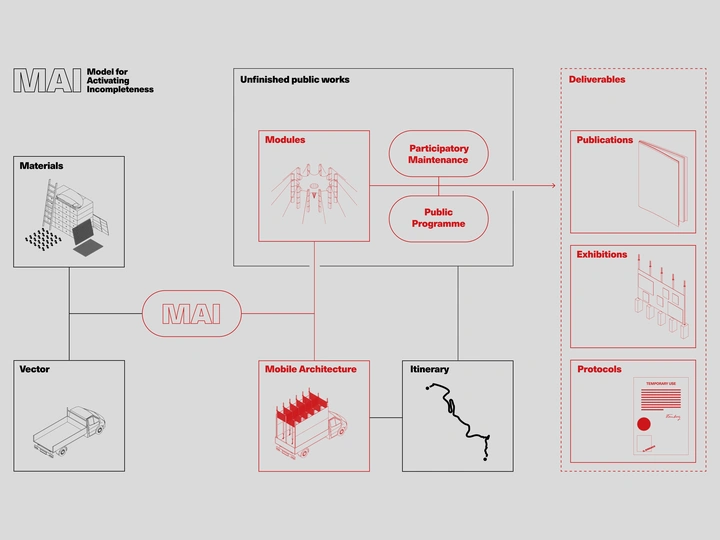
MAI is an operational framework for activating unfinished public works, through spatial and curatorial practices.
Although most visible in Italy, incompleteness has become a shared contemporary condition. Across Europe, landscapes are punctuated by unfinished stadiums, museums, public infrastructure. Never completed, these structures embody a deeper and persistent crisis of public institutions.
As architecture seeks alternatives to demolition in the age of climate change, MAI proposes a third path for unfinished public works: activation. Neither completing nor demolishing them, MAI makes incompleteness public through minimal, reversible and culturally driven interventions.
Drawing inspiration from Danilo Dolci's reverse strike (1956) and Mierle Laderman Ukeles' Manifesto for Maintenance Art (1969), MAI redefines maintenance as both a design strategy and a performative practice.
Its strategy combines spatial and curatorial practices, using temporary cultural programmes as devices for transformation across different temporalities - short, medium and long term.
MAI operates through four interrelated spatial devices. The Mobile Architecture is a vector that travels, connects, and transports. The Modules are spatial devices that allow accessibility, safety and public assembly. Participatory Maintenance is a performative action that involves local partners into cleaning and repair operations. The Public Programme is a curatorial device that turns incomplete spaces into temporary platforms for culture.
MAI activates unfinished public works without completing them. Instead, incompleteness becomes a civic opportunity for collective action and institutional experimentation.
First developed through doctoral research project on unfinished public heritage and currently being tested with interditta on two case studies in Italy, MAI is conceived as an open methodology to be challenged and expanded across diverse European contexts.