Documenting Fluid Places
I am an emerging urban researcher and spatial practitioner from Brazil based in Berlin. My work combines urban research and artistic inquiry to investigate how people perceive, experience, imagine, and ultimately build relationships with everyday urban spaces.
I trained as a Civil Engineer before spending more than ten years managing international projects, organisational change and multidisciplinary teams across six different countries. Seeking to better understand the relationship between cities and society, I recently completed a Master's in Urban Management at TU Berlin, where my research examined how public cultural facilities can contribute to spatial justice and social cohesion.
While studying Urban Management, I joined an interdisciplinary Art & Science course to explore questions that conventional urban research could not fully address. That experience introduced me to artistic research as a way of investigating. The resulting project, Documenting Fluid Places, culminated in a small exhibition and became the starting point of my current practice.
Living between cultures has influenced the way I perceive urban environments and the questions I ask about them, questions of identity, movement and belonging. I am particularly interested in overlooked everyday spaces and in how observation and imagination can reveal new ways of understanding them. Photography helps me observe these places with greater attention, while collage allows me to reinterpret them and explore alternative possibilities.
My practice is still evolving, and I see interdisciplinary collaboration as an essential part of that process. I am interested in working with architects, artists and researchers to develop new ways of investigating how everyday urban spaces shape identity, belonging and our collective experience of the city.
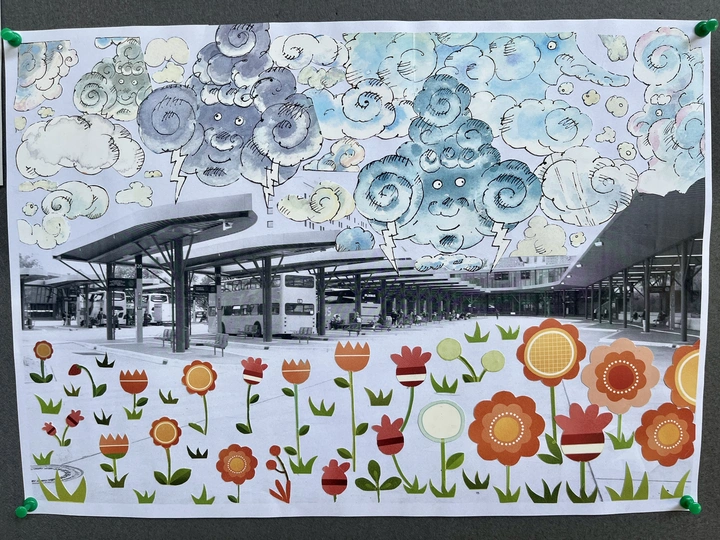
Documenting Fluid Places is an artistic research project that explores how overlooked everyday urban spaces influence the way we experience, imagine and build relationships with the city through observation and imagination. It began during an interdisciplinary Art & Science course at TU Berlin, where, guided by Marc Augé's concept of non-places and Zygmunt Bauman's reflections on liquid modernity, I started investigating how photography and collage could reveal the relationship between non-places and liquid modernity.
Experiencing the city through a different cultural perspective has made me more attentive to the spaces people often overlook, places that structure everyday life, but rarely become objects of reflection. Rather than seeing these spaces as anonymous or empty, I am interested in how they influence movement and belonging, as well as how they shape our experience of contemporary cities.
Photography allows me to slow down observation and document these spaces as they are. Collage introduces another layer by rearranging fragments of reality and opening space for imagination. Inspired by Brazilian writer Clarice Lispector's reflections on how adults are sad and solitary beings, whereas kids are not, because they have fantasy and imagination, I use collage to question the functional way adults often perceive cities and to recover the openness with which children encounter the world.
While rooted in artistic research, the project is also informed by my background in urban research, where I have explored questions of spatial justice, public space and social cohesion. Through collaboration with architects, artists and researchers, I see Documenting Fluid Places evolving into exhibitions, collective walks, workshops and other forms of spatial investigation that encourage conversations about the overlooked spaces that connect our cities and our daily lives.