Planning in the Meantime
Lilet Breddels
Robert Gaspard
Nadiya Makushynska
Daryna Pasyuta
Ekim Tan
Fulco Treffers
Marjo van Schaik
Daryna Pasyuta is an independent urbanist and spatial practitioner with over fifteen years of experience in urban planning, participatory design, and spatial policy. She has built her practice across Ukraine and the Netherlands — working on community engagement, recovery planning, and cross-cultural collaboration.
After more than a decade of practice in Ukraine — including work on urban masterplans, heritage rehabilitation, and municipal strategy — she spent two and a half years at INBO, a Dutch urban planning firm, following Russia's full-scale invasion of Ukraine. This deepened her international experience and her ability to bridge Ukrainian and European professional contexts.
Since returning to Ukraine in 2024, she has worked as an independent consultant across fifteen cities, leading participatory processes with municipal administrations, civil society organisations, and displaced communities. Her projects range from urban recovery strategies for frontline territories to civic infrastructure for cities absorbing large numbers of internally displaced people.
Notable projects include: the coordination of a city-wide participatory initiative in Chernivtsi — including the PoruCh civic platform and a civic action game co-developed with Play the City and INBO; demographic research with the Mariupol community in exile, in collaboration with Ro3kvit and Harvard Extension School; and Fight, Flight or Freeze — an exhibition she conceived with Dutch designer Marjo van Schaik at Dutch Design Week 2025 in Eindhoven, for which she authored the sketches that became textile works and led a public workshop.
She contributed to Ukraine's participatory planning toolkit and the national Urban Planning Code reform. Her interests lie at the boundary between spatial practice, community agency, and the politics of reconstruction — and in the question of what participation means when the future cannot be assumed.
Reconstruction frameworks were built for wars that ended. They assume a before and after. But no one knows when this war ends — or the next one. Ukrainian communities are not waiting.
Over the past three years, I have worked as an independent practitioner across fifteen Ukrainian cities and beyond — leading participatory processes under conditions that conventional urbanism was not built for. Three cases define my practice.
In 2025, I co-led demographic research with the Mariupol community — under Russian occupation since 2022. Through surveys and interviews with over 270 displaced residents, we gave voice to people whose city has been erased. The research revealed something planning rarely measures: the fierce persistence of identity and the will to shape decisions about a place you can no longer reach.
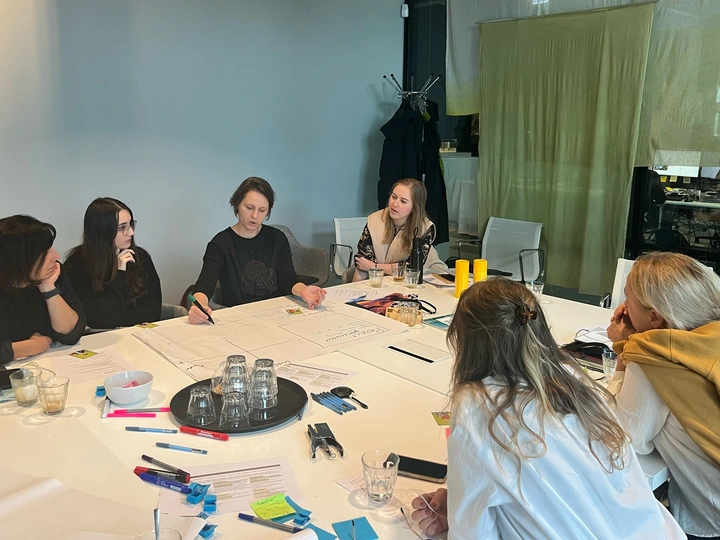
That same year, I initiated Fight, Flight or Freeze — an exhibition at Dutch Design Week in Eindhoven. I developed the concept, authored sketches that became textile works, and co-created the installation. Through a public workshop, I invited participants to face fear and uncertainty through drawing — a space where displaced people and European audiences met in the shared language of embodied experience.
In Chernivtsi — a city that absorbed 80,000 displaced people, nearly one in three residents — I coordinated a full urban project: the PoruCh platform mapping free services for displaced and host residents, and a civic action game co-developed with Play the City and INBO. Not planning for return, but building belonging in a place that was not home.
These three cases reveal participation as something broader than a method: a practice of continuity — maintaining presence, voice, and agency in the middle of things, with no clear endpoint.
This is not only a Ukrainian challenge. The questions being worked through here now will matter far beyond Ukraine.