Post Defence Architecture
Berlin-based visual artist originally from western Romania, working across photography, moving image, installation, sound and text. Trained in Clinical Psychology, I use image-making as a form of long-term observation and spatial research.
Drawn to obsolete infrastructures, specific landscapes, ritual, memory, ecological processes and the relationship between the built and the natural environment. My work has explored dream narratives translated into immersive installations, developed in collaboration for the Women in Architecture Festival, while my experimental films have been regularly selected for screening at kinema ikon, Simultan Festival and Labocine's Science New Wave. Alongside my artistic practice, I have worked for more than a decade as a freelance photographer and filmmaker documenting architecture, cultural institutions, conferences and public programmes, collaborating with organisations including Humanity in Action, the German Association of Landscape Architects and Haus für Poesie, developing a documentary approach that combines visual sensitivity with the ability to work collaboratively within interdisciplinary environments.
Collaboration with architects has been a recurring part of my practice. I am increasingly interested in artistic research as a process that connects architecture, ecology, moving image and local knowledge. I see conversation, fieldwork and experimentation across disciplines as essential to the way I work.
It's February when I arrive to the castle of Guardias Viejas, on the Spanish coastline. The bunkers, just a few meters below, were meant to block troops coming from Málaga, the castle's cannons used to watch for pirates. I go inside one of them and look out. My field of vision restricted and divided, the small space becomes a camera obscura. I run my finger along the a abrasive aperture edges. It's thick and durable, an extension of the rock conglomerate. The illusion of the uninterrupted landscape is maintained, the construction is absorbed by the geology. Designed to resist weather and bullets, the architecture slowly yields. I am looking to understand how spaces retain traces of previous uses but are inhabited differently throughout time.
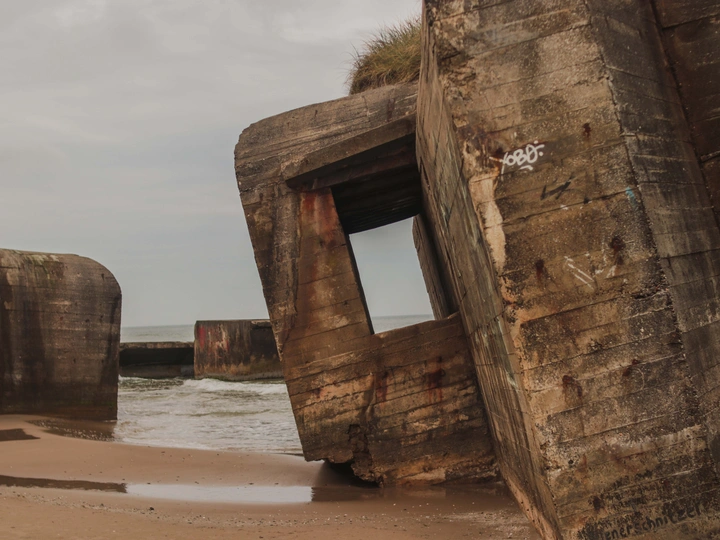
August. I climb into a collapsed structure, one of the 36 bunkers, north of Lokken. The dunes are swallowing several parts. Once inside, the floor is tilted and the horizontal line of the sea is visible within a 45 degrees shifted corridor. I can hear a Danish family outside, a tent between the remnants of concrete. Some people climbed all the way up on the highest surface and are taking selfies. What used to serve the Atlantic Wall against allied forces is now a backdrop for surfer boards, early joggers, dogs and vegetation taking over the abandoned roofs.
Labenne, another german bunker, eroded by the sea, full of vibrant graffiti and wet green algae. Three coastlines, same architectural gesture.
These observations form the beginning of an ongoing research into obsolete architectures of defence across Europe, looking at how these spaces are reclaimed, be it intentional, accidental or ecological. Combining imagery, field recordings and text, I want to examine how these spatial artifacts are successively occupied by flora, play and erosion, through forms of occupation their original function could not anticipate.