"Cheaper, Happier, more Resourceful"
Enrico Gobbi
Michele Marini
Lemuel Pedrotti
MOLE COLLAB is an architectural practice funded by Michele Marini in 2022
Michele is an architect and researcher based in Berlin.
After obtaining a Double Master's Degree from Xi’an University of Architecture, he graduated cum laude from the Politecnico di Milano.
He worked for several offices in Berlin, including June14 - Meyer-Grohbrügge & Chermayeff, Nieto Sobejano Arquitectos, Kuehn Malvezzi, and Baumschlager Eberle Architekten. He has mainly worked on architectural competitions and has received notable recognitions, including 2nd prize in the New European Parliament competition together with Kuehn Malvezzi and Jabornegg & Pálffy Architects, among others.
In 2023, MOLE COLLAB won Europan 17 in Trondheim (NO) with the project "A Home for All". He then continued collaborating with the Municipality of Trondheim, working on a nursing home and housing project.
In the same year, he was invited by Alberto Ferlenga and Associates Architecture to the cultural event "Brescia Bergamo Capitale della Cultura 2023". He contributed with a project exploring a possible future for his hometown of Brescia, entitled "Unbounded Area". MOLE COLLAB was invited as a young emerging Italian practice together with (ab)Normal, Armature Globale, Fondamenta, Piovenefabi, Studio Ossidiana, Supervoid Architects, VG13, and others.
In 2025, the office received a Special Mention for the project "In Between" in Amersfoort (NL). In September 2026, the office will take part in a workshop organised by the municipality on the future development of the project. MOLE COLLAB also undertakes construction projects and research activities.
Michele is also an academic researcher currently working at the Technical University of Munich (TUM), Chair of Urbanism and Housing, with Prof. Stephen Bates.
He has given lectures at the AHO-Oslo School of Architecture and Design, ETSAM-Universidad Politécnica de Madrid, DAD-Università degli Studi di Genova, and the TUM-Technical University of Munich.
In European cities, housing affordability and environmental responsibility are framed as competing priorities. Current regulatory frameworks increasingly mandate hyper-technical, high-performance solutions. These legislative impositions often do little for real sustainability, instead, they artificially inflate construction complexity, systematically privileging expensive proprietary materials to fuel the market of specialised manufacturers. The problem is not in the presence of sustainability standards (that are necessary) but, regulations sometimes measure sustainability through technical performance rather than through resource efficiency, adaptability and long-term social value.
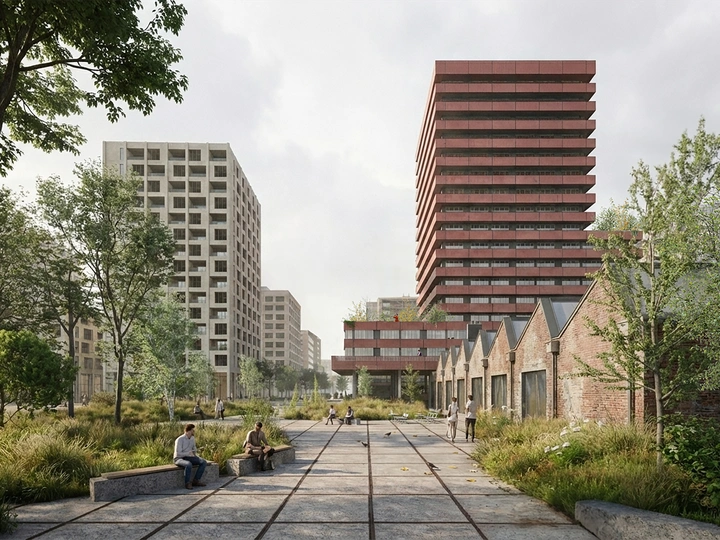
This proposal comes from "In Between", a Special Mention winning project for Europan 18 in Amersfoort (NL). In this project, we treated architecture not as a fixed asset, but as an evolving resource, integrating reclaimed demolition materials and industrial prefabrication to simplify assembly, maintenance, future transformation and reduce the costs to foster social sustainability.
Building on this experience, the research wants to question the assumption that environmental responsibility requires higher costs and tech-heavy reliance. By shifting focus from high-cost technology to low-tech assembly, circular material flows, and spatial adaptability, we can drastically lower initial and long-term costs.
This directly connects affordability to well-being: when housing is financially accessible and structurally flexible, inhabitants gain autonomy, reduced financial stress, and spaces that adapt to changing lives, it means making housing and dwelling genuinely "happier."
The research aims to expand this inquiry into a critical framework for architects, policymakers and industry, exploring how rethinking regulatory complexity and market-driven excess could foster a more socially and environmentally sustainable spatial culture.