Nulo - Portable luminaire for urban nightscapes
My work is driven by an ongoing exploration of interaction, materiality, and cultural research. This approach is reflected in themes such as the urban environment, social contexts, everyday objects, and the conscious, material-appropriate use of resources.
Through subtle interventions, I create functional objects that open up new possibilities for interaction and invite people to reconsider their relationship with everyday situations.
I studied Industrial Design at the HTW Berlin University of Applied Sciences, where I completed my Bachelor's degree, and at Burg Giebichenstein University of Art and Design Halle, where I earned my Master's degree.
Alongside my studies, I gained professional experience in a range of design studios, including ErtlundZull, an interior design studio and metal workshop in Berlin. I also worked as a research assistant to Prof. Dr. Pelin Celik at HTW Berlin University of Applied Sciences and later taught as a lecturer in 3D Fundamentals at Burg Giebichenstein University of Art and Design Halle.
I was nominated for the German Design Award Newcomer 2027, and my work has been exhibited internationally, including at Salone del Mobile in Milan, Dutch Design Week in Eindhoven, and exhibitions in Munich and Berlin.
Who owns the light? Who owns the city? Urban space is shaped by a dense and often conflicting set of interests, and this becomes especially visible after dark, in the interplay between public life and artificial lighting. I began this project after noticing a spatial mismatch: the areas we illuminate at night are rarely the places where people actually gather. Urban lighting has historically been designed around traffic and circulation, streets, crossings, thoroughfares, while spaces of genuine social encounter, such as parks and informal common areas, remain in the dark. This discrepancy became the starting point for my inquiry.
I chose the park as an exemplary site to investigate this tension, since it sits at the intersection of civic infrastructure and individual need, a place that is public by design but social only through use. Through observation and iterative prototyping, I asked how lighting itself could be redefined, not as a tool for control and visibility, but as an instrument for enabling encounter.
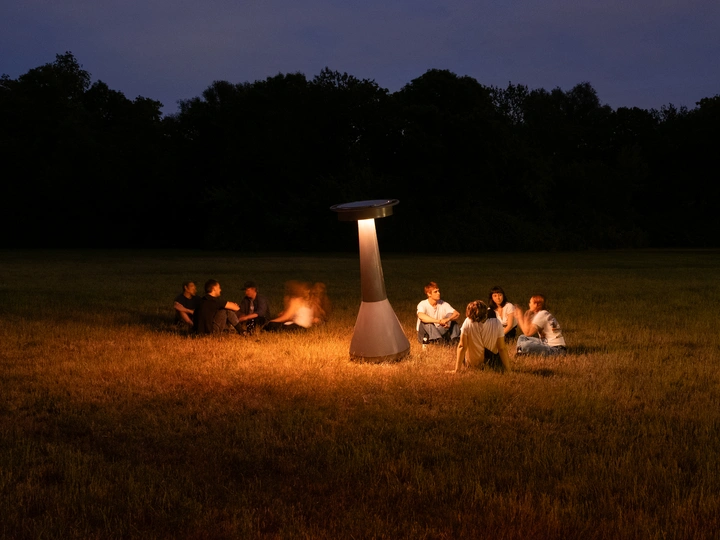
This inquiry led to Nulo, a luminaire that deliberately brings light into social rather than functional space. Its form invites interaction and allows for flexible positioning, rather than prescribing a fixed use like conventional street lighting. A warm, downward directed, and intentionally minimal light creates an atmosphere that feels sheltering rather than surveillant.
What I find most successful about Nulo is this shift in role: it stops behaving like infrastructure and starts behaving like furniture, an object belonging to the users of a space rather than to the systems governing it. It also raises a broader question about who shapes the after dark city.
Looking ahead, I see Nulo less as a finished product than as a prototype for a different logic of urban lighting, one that could be tested across other overlooked social spaces and that opens further questions around participation and shared ownership of public infrastructure at night.