Mapping Bonds: how situated art regenerates places
Jeanne Varaldi is a French artist and designer based in Paris working at the intersection of spatial research, visual arts and urban practices. She develops commissioned and institutional projects alongside her research, including public artworks for the City of Paris (Carreau du Temple, 2024) and the “1 Immeuble, 1 Œuvre” programme (2023), as well as exhibitions in France and internationally (Galerie Bertrand Grimont, Porte B, Homesession Barcelona).
Her work explores ordinary territories—landscapes shaped by agriculture, industrial activity, small-scale economies and post-industrial transformations—through situated approaches combining urban research and visual arts. She uses fieldwork-based methods such as walking, drawing, mapping and conversations with inhabitants to reveal the ecological, social and affective dimensions of everyday environments.
Her practice is grounded in participatory and narrative tools, including collective mapping, sensory walks and emotional cartographies, positioning storytelling as a critical instrument for understanding and transforming territories. These methods engage with contemporary debates in architecture and urbanism on situated knowledge and lived experience.
Alongside her artistic production, she develops pedagogical and editorial work on the relationship between art, architecture and territory, notably through the cycle “Drawing the City” at Sciences Po (Urban School and Maison des Arts et de la Création), addressing arts, urbanism and environmental questions. She is also engaged in cultural urbanism networks.
Through the LINA platform, she aims to deploy Mapping Bonds across European contexts, bridging artistic research with architectural and urban policy.
How does situated creation shape regenerative territories — and how do we capture the bonds connecting artists, inhabitants, and ecosystems, when these very ties drive systemic care?
Mapping Bonds addresses these questions by proposing a critical counter-mapping methodology to document and evaluate situated artistic interventions in hybrid landscapes shaped by post-industrial transitions, infrastructure, and rural-urban shifts. Moving away from quantitative indicators, this research develops a narrative, participatory toolkit designed to capture the affective, social, and ecological impacts of site-specific spatial practices. The methodology is currently being piloted at Casabranca (Portugal), an abandoned railway settlement of 80 residents undergoing artistic and ecological reactivation, supported by the Évora 2027 European Capital of Culture programme
Challenging the paradigms of hydraulic modernity — which piped, drained, and erased water from urban planning — Mapping Bonds mobilizes water as both a conceptual medium and a visual grammar. Inspired by Baptiste Morizot’s living webs philosophy, water reveals the living connections that seep, pool, and resurface across porous territories.
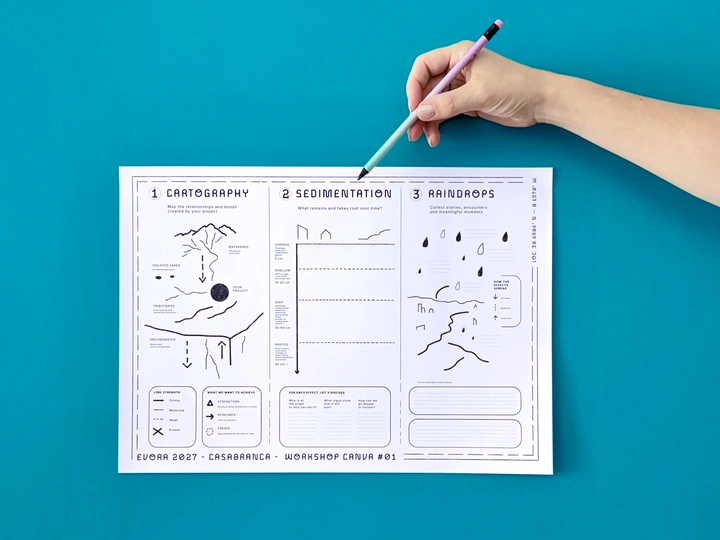
Three tools carry the method: Hydrographic Network maps a project's ecosystem as a river system — its watershed of inspirations, its groundwater of community bonds, its isolated lakes calling for bridges to be built. Receding Waters acts as a fieldwork protocol for legacies, observing the fertile sediments left on the shore once an artistic process recedes. Raindrops collect anecdotes and meaningful moments — small, individually unremarkable, collectively a portrait of transformation no metric could draw.
Grounded in Donna Haraway's situated knowledges and Tim Ingold's dwelling perspective, Mapping Bonds is built to travel across European bioregions — providing architects, curators, and institutions with tools to evaluate contextual, community-led creation.