Breathe Within the Unbreathable
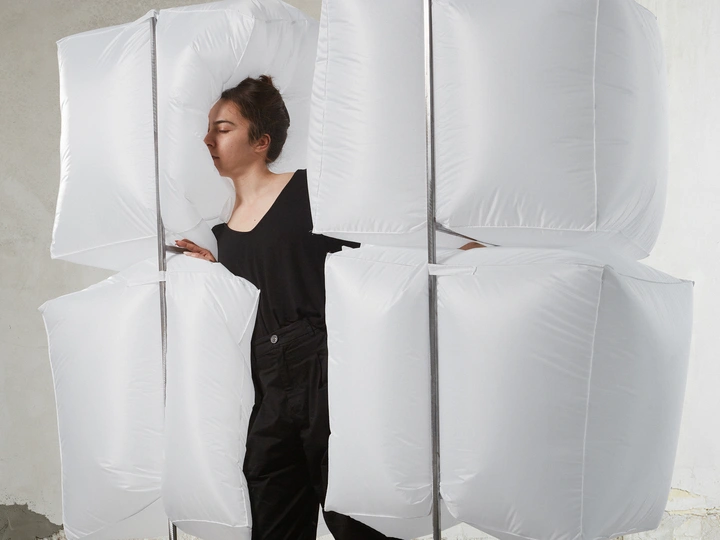
How does space reveal the conditions under which we live?
I am a spatial designer and artist based in Amsterdam, working between spatial design, interaction, and artistic research. I hold a Master's degree from Design Academy Eindhoven (2025) and a Bachelor of Design in Interior, Building and Environmental Design from Shenkar College of Engineering, Design and Art (2022, Dean's List).
My work operates at 1:1 scale, creating environments that can be entered and moved through. Space itself becomes a research tool: it lets me test how environments shape perception, behaviour, and interaction. I am interested in how spaces act on us physically and sensorially, and in how material structures interact with abstract- yet ever-present systems, like technology, infrastructure, and social convention.
Breathe Within the Unbreathable was exhibited at DAE graduation show, Dutch Design Week Microstad (2025) and an earlier iteration, Breathe In Order, was shown at Deep Objects, De Fabriek, Eindhoven (2024). The work has been covered by Trouw.
Air is an active medium that shapes how we exist and relate to the environment. Always present, it is rarely noticed until breathing becomes difficult. Nerea Calvillo proposes thinking about air as the indicator of the Anthropocene. Wildfire smoke, urban smog, and airborne disease like COVID-19 affect how we breathe.
Conditioning the air refers not only to its physical quality and control through technologies such as air conditioning, as Daniel Barber emphasizes, but also to the socio-political shaping of public space through climate management. As societies increasingly navigate threats carried through the air, breathing becomes an interface between body and world- both physically and politically.
The work stages conditions of breathing within constrained environments. By doing so, it reveals the act of breathing as one that is governed by cultural, social, and political conditions that shape respiration. The installation is based on inflatable elements that respond to the participant’s breath. As users breathe, it reacts in real time and begins to influence their body position and their breathing patterns. This creates a feedback loop between the body and the environment.
The installation was exhibited at Dutch Design Week 2025, where visitors used it one at a time. It revealed how unevenly breathing capacity is distributed and the role of training: visitors trained in breathwork gained control over the movement, while others lost their rhythm and ran out of breath within minutes.
What the installation does at the scale of a single body, buildings already perform at the scale of hundreds. Architecture conditions the air. The work now extends to architectural scale: mapping a building's air conditions and ventilation through environmental sensing and developing interventions where visitors breathe with the structure, or against it. Instead of trying to improve or optimize breathing, the project shifts attention to awareness. How and what, are we breathing now?