The Bread Wall: A Recipe for Gathering
I am a computational designer and architect from Damascus, based in Berlin. I grew up in a family where wood was worked by hand, and in 2016 I began combining woodcraft with parametric design. My practice brings algorithms, digital fabrication, and hand-finishing together to reveal new possibilities in irregular and discarded material.
My previous projects established this approach at different scales. Waste to Fit used scans and shape-packing algorithms to assemble carpentry leftovers into furniture. Tree Fork Structures, developed for my Master's thesis, used 3D scanning and computational alignment to turn storm-fallen tree forks into larger structural assemblies.
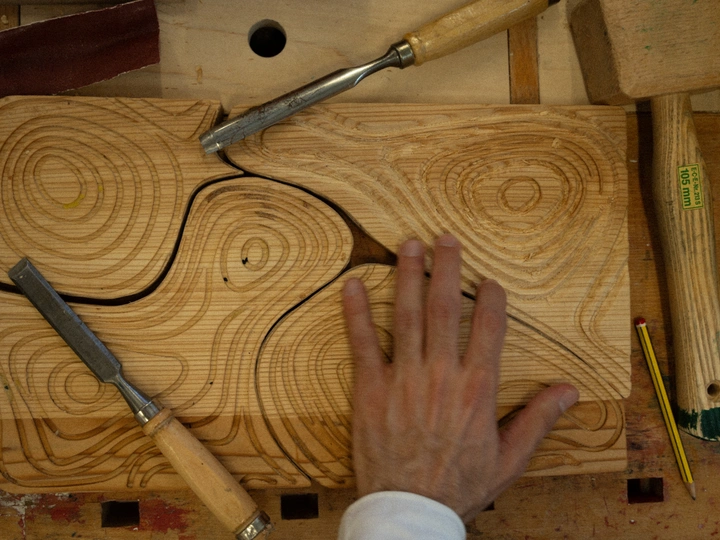
Bread Molds brings this material research together with cultural memory and participation. In 2022, I made the first physical mold as a test for a recipe shared by my grandmother. That experiment is now developing into an architectural installation: a changing wall of removable molds, hosted baking sessions, and a communal table where visitors can taste the bread with sweet and savoury accompaniments from different backgrounds.
In my professional work, I use computational tools on large public projects. My independent practice asks a different question: how can those tools help us work more carefully with material that already exists? The algorithm does not replace craft. It helps me understand irregular geometry, reduce waste, and build relationships between parts; the hand gives the final object its surface and character.
I am mid-career in architectural practice and still emerging as an independent artist. Through LINA, I want to develop this work with local material partners, public participants, and institutions that see architecture as both a physical and social practice.
Bread Molds is a participatory architectural installation built around a changing wall, a baking station, and a communal table.
In 2022, I made the first physical wooden mold as a test for a bread recipe shared by my grandmother. That experiment became the starting point for a larger project. I am now developing the mold from a hand-held object into a spatial system. Six parametrically designed molds will hang across a large wall like leaves carried by wind. Their geometry and arrangement will respond to the dimensions of the site and the available wood. I also plan to test reclaimed boards from old family furniture.
The molds will not be fixed exhibits. During hosted baking sessions, visitors will remove them from the wall and use them to make bread. Empty spaces will record which molds are active. After baking and cleaning, the molds will return in new positions, changing the installation throughout the exhibition.
The bread will be shared at a communal table. My grandmother's recipe is the personal starting point, not a cultural boundary. I tested the first mold with hummus, German and Iranian dips, jam, and other sweet and savoury combinations. Visitors will be invited to taste the bread with familiar accompaniments or introduce their own, allowing different food memories to meet.
The parametric method operates at two scales: it uses irregular wooden boards efficiently, then adapts the wall composition to each site. My earlier Tree Fork Structures and Waste to Fit projects established this workflow by scanning irregular natural and discarded wood and assembling it into larger structures.
The project connects the scale of the hand, the wall, and the shared table. It treats memory as something people can use, taste, reinterpret, and pass on, not an object preserved behind glass.