Borrowed Ground
I graduated from the University of Architecture, Civil Engineering and Geodesy in Sofia in 2022, where my master thesis investigated spaces of power and authority through the former Communist Party House in Sofia, examining its transformation from a symbol of political power into a place of collective memory and civic expression.
Between 2022 and 2024, I lived and worked in Porto, where I developed a deeper understanding of spatial experience and phenomenological approaches to architecture. Working on public buildings and international competitions allowed me to engage with different scales of architectural practice. During this period, I initiated the photographic research project Quem Claraboias?, exploring Porto’s overlooked skylights as cultural and spatial phenomena.
After returning to Bulgaria, I continued exploring architecture through dialogue and collective processes. Together with colleagues from different disciplines, we developed Faculty Number, a platform reflecting on architectural education and the everyday relationships within the university environment. The project resulted in a year-long public drawing workshop documenting life at UACEG, currently being developed into a small publication.
Since 2024, I have been a studio assistant in Public Buildings at UACEG Sofia, exploring design methodologies based on conceptual models, critical thinking and speculative approaches. Within this role, I had the opportunity to lead an independent studio with Erasmus students, experimenting with more open collaborative education.
My current practice develops between architecture, photography, research and artistic experimentation. I am interested in transforming observations of ordinary conditions into critical narratives, spatial experiences and alternative forms of representation.
Whenever the tide rises, Venice quietly manufactures new ground.
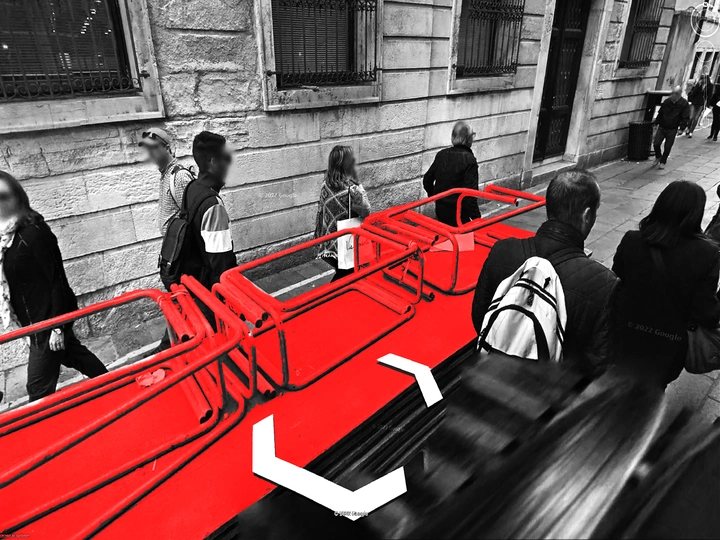
Municipal workers assemble steel platforms into temporary paths that redraw the city's geography. Squares become fragmented lines above the water, movement is compressed, and the familiar city briefly gives way to another. When the flood recedes, these structures are dismantled and stacked across the public realm, where they once again become almost invisible—anonymous piles resembling construction debris, waiting for the next tide.
Borrowed Ground begins with this overlooked cycle of appearance and disappearance.
Neither entirely temporary nor truly permanent, these platforms exist in a constant state of becoming. Stored as silent engineering objects, they seem detached from everyday life; assembled above the water, they produce inhabitable ground, reorganise flows and redefine encounters. Their significance lies not only in what they solve, but in what they reveal: a forgotten possibility of architecture rooted in adaptation, care and collective use.
Through photography, mapping, speculative collage and spatial installation, the project investigates these platforms alongside Venice's wider landscape of temporary maintenance—bridge ramps, scaffolding, fences and structural supports. Often perceived as interruptions within one of the world's most celebrated cities, these elements form a hidden scenography of survival, continuously negotiating between fragility and permanence.
Rather than proposing another technical solution, Borrowed Ground seeks to reveal how these anonymous infrastructures might become carriers of a different architectural imagination. Can structures born from necessity evolve into places of encounter, belonging and care? As cities increasingly depend on temporary adaptations to confront environmental uncertainty, the project asks when the temporary becomes permanent—and whether the infrastructures that sustain everyday life can become the grounds of a new urban beauty.