The Convivial Architect
Marco Iembo is an architect, researcher and curator whose work explores architecture as a civic and cultural practice. His research focuses on urban regeneration, adaptive reuse and participatory design, investigating how architecture can strengthen collective agency and respond to contemporary environmental and social challenges.
He is co-founder of collettivo ctrl+S, an interdisciplinary practice operating across architecture, art and public space through installations, workshops, exhibitions and site-specific interventions, often in rural areas and overlooked urban contexts. Alongside his independent practice, he has collaborated with internationally recognised offices including Studio Mumbai, Studio Anne Holtrop and andreacaputo.com.
In 2025 he was awarded the Premio Berlino, leading to a research residency at Atelier Fanelsa in Berlin. His work has been presented through lectures, exhibitions and public programmes at institutions including Aedes Metropolitan Laboratory, ADI Design Museum, Politecnico di Milano, and internationally in Hong Kong and Shanghai. It has also been featured in publications such as Interni, Artribune, Elle Decor and Casabella.
Across his practice, architecture is understood less as the production of objects than as a medium for connecting people, knowledge and places through collaborative and climate-conscious processes.
Architecture is increasingly expected to respond to challenges that cannot be solved through buildings alone: climate transition, social fragmentation, technological disruption, and the decline of collective public life. Yet architects are still largely understood as authors of objects.
What if the architect's primary role was no longer to design buildings, but to connect people, knowledge, and resources?
Inspired by the ideas of Ivan Illich and Colin Ward, The Convivial Architect investigates an alternative model of architectural practice. Rather than delivering solutions, the architect becomes a mediator who enables communities to imagine, negotiate, and collectively shape their environments.
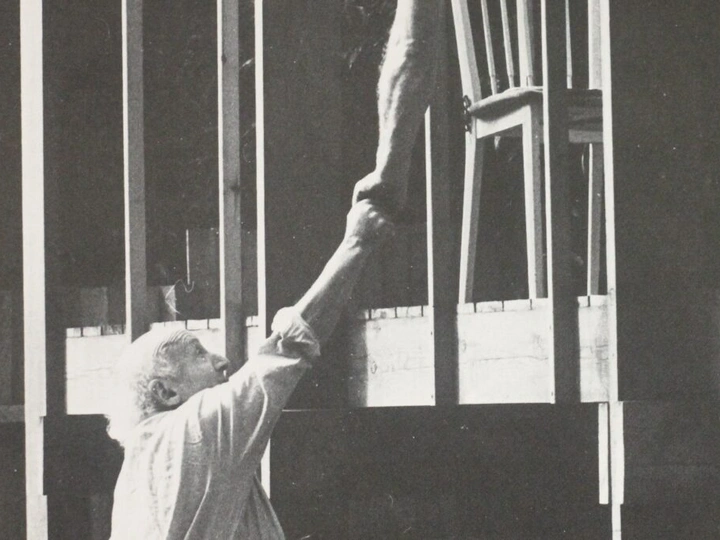
The research revisits the work of Walter Segal, Lloyd Kahn, Enzo Mari and others, whose practices challenged the separation between designer and user through self-building, open knowledge, and collective making. Their work is approached not as historical precedent, but as an unfinished project whose principles can be reinterpreted today.
Architecture now operates within an ecosystem of collective intelligence. Environmental knowledge, digital technologies, craftsmanship, institutions, and everyday experience all contribute to the production of space. The challenge is to orchestrate these forms of intelligence without diminishing human agency.
The Convivial Architect is a practice-based research project developed through collaborations across Europe. Each collaboration tests architecture as a civic practice of mediation through workshops, dialogue, collective interventions, and the activation of local knowledge.
Rather than celebrating the architect as an individual author, The Convivial Architect proposes a practice that expands the capacity of others to act.