Choreopolitics: rehearsing less violent futurities
Zoé Lefèvre
danced stances is a Geneva-based duo, Aurélie Dupuis and Zoé Lefèvre, working at the intersection of architecture, performance and film. Trained as architects and urban researchers at EPFL, TU Munich, Yale University and Paris-Malaquais, they examine the mutual constitution of choreographies of power and the built environment.
They met in 2019 at EPFL where Aurélie began a PhD on the normative structures shaping urban space and the performative practices that resist them, and Zoé worked as a research assistant on similar concerns. In 2024, after Aurélie successfully completed her PhD, they founded their practice to extend this research into collective, embodied experimentation.
danced stances produces conceptual figures, performances and moving images that experiment with the friction between systemic rigidity and the persistence of willfull bodies, architectures, and words. Their work evolves through close, long-term collaboration with performers, choreographers and filmmakers, and through performance itself, used as both a research tool and a public form of expression.
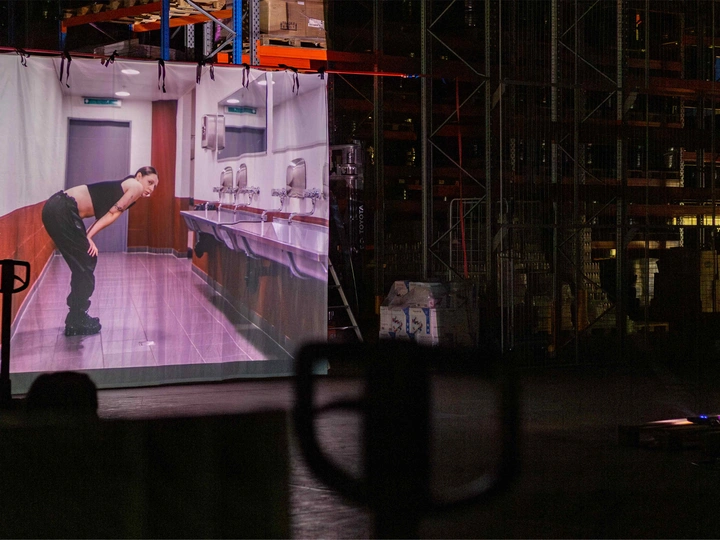
Since 2024, danced stances has created and performed site-specific works in activist and art spaces in Geneva, and directed the film Demi-temps, shot at the Geneva stadium with lisa laurent and Nathalie Berger, and presented as part of the PAV Living Room festival.
In 2026, danced stances was invited by the Geneva Contemporary Art Fund (FMAC) for a closed public art competition. They are currently leading the research-creation project Choreopolice/Choreopolitics, for which they have received research grants from various institutions in Switzerland. This project forms the core of their upcoming video installation and performance series at the Dance First Think Later biennial (2026).
They regularly participate in juries, write in international research journals and magazines, and give lectures and workshops (HEAD, EPFL, ETHZ, Ghent University).
“Who is doing the doing, and for whom?” This question surfaced within minutes of a somatic exercise led by Brazilian artist and choreographer Catol Teixeira during a workshop we conducted, and now drives our research-creation project, Choreopolice/Choreopolitics. In our control societies, power operates less through repression than through a “logistics of consensus” that conditions and smooths collective and individual movement. Choreopolice names the regulation of presence; choreopolitics, its collective undoing. Our practice sits at their intersection, tracing how bodily movement and spatial control shape one another.
Asymmetry is lived daily in Greater Geneva, a cross-border territory where French and Swiss regimes of movement overlap, governing over a million residents and commuters through unequal rights to move, participate, and come together—questions inseparable from the political organization of visibility and access. As two French-Swiss, white, lesbian, cis-passing individuals, we move through this landscape unevenly. Through working with dancers and filmmakers, we ask: How could architecture and dance become implicated in one another? How can a transdisciplinary collective challenge the layers of historical violence that structure the movement of bodies within the city?
Our project is rooted in Geneva and its artistic communities and spaces. Together with eight other artists, we occupy, negotiate and somatically archive vacant or soon-to-be-demolished spaces, naming their invisible mechanisms and training our bodies and imaginations to trace new pathways away from pre-established ones.
Recently expanded into education (HEAD Genève) and visual arts (Biennial Dance First Think Later), the project is reaching the end of its first phase. Joining LINA is a crucial next step for bringing our grounded, transdisciplinary collective methods and research questions into international dialogue.