Paradigme: New voices for nature
Ingrid Haga
Paradigme was founded by Ingrid Haga and Nora Ulrikke Andersen, whose backgrounds in architecture, climate adaptation, political science and public discourse form the interdisciplinary foundation of our practice.
Ingrid is an architect and writer whose work focuses on climate adaptation and the relationship between nature and architecture. Her practice explores how architecture can respond to changing ecological conditions and how nature can become a premise for design.
Nora is a political scientist, writer and public commentator working at the intersection of politics, economics, urban development and the built environment. Through writing, research and public debate, she explores how political and economic structures shape cities, access to space and our relationship with nature.
We founded Paradigme because we saw a shared gap between disciplines and generations. Since then, we have built a network connecting emerging practitioners with major Nordic institutions and created collaborations across seven Scandinavian architecture and design schools. Our first anthology brings together 41 projects and is developed in collaboration with Oslo Architecture Triennale 2026, Scandinavian Universities and published by Press Publishing.
Our work combines research, editing, curating, writing, network building and public debate. We are particularly interested in creating spaces where architecture can meet politics, ecology, art and society, and where emerging practitioners can participate in conversations usually dominated by established institutions and professions.
Together, we approach architecture as a cultural and political practice with the potential to reshape relationships between people, nature and society.
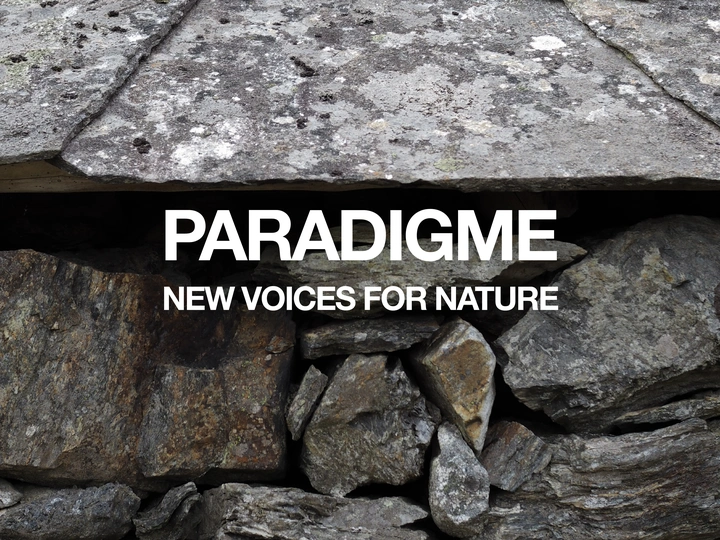
Paradigme: New Voices for Nature is a Nordic interdisciplinary anthology and platform bringing together 41 projects by emerging voices across architecture, art and design. Developed in collaboration with Oslo Architecture Triennale 2026 and published by Press Publishing, it asks how a new generation can rethink the relationship between nature, architecture and society.
The project emerged from a concern that, while young practitioners are producing urgent work on climate change, biodiversity loss, resources and social inequality, their perspectives often remain within educational institutions and outside established professional and public discourse. Paradigme creates an independent platform for these voices.
Following an open call across Scandinavia, contributions were selected from architects, landscape architects, artists, designers, researchers and writers. The projects are organised around five themes: Culture, Biodiversity, Resources, Climate Adaptation and Power. Together, they approach the environmental crisis not only as a technical challenge, but as a cultural, ethical and political one.
Paradigme has built a network spanning and collaborates with the Oslo School of Architecture and Design (AHO), Oslo National Academy of the Arts (KHiO), Norwegian University of Science and Technology (NTNU), Bergen School of Architecture (BAS), Chalmers University of Technology, the Royal Danish Academy and Aarhus School of Architecture. The anthology launches during Oslo Architecture Triennale in September 2026, with pre-launch at the Oslo Urban Week, launches at participating schools and public events across Scandinavia.
Beyond the publication, Paradigme is intended as a lasting Nordic platform for emerging voices, interdisciplinary exchange and public debate, connecting ideas that often remain within architecture schools to the institutions, professions and communities shaping the built environment.