A Window for a Tree
I am an architect and industrial designer, trained in Madrid and based in Barcelona. My work is driven by sustainability, a connection to nature, and a belief that function should lead over style. I currently develop independent projects that sit at the intersection of architecture and product design — from small-scale sustainable dwellings to everyday objects, always starting from the same instinct.
My method starts from simple, literal ideas that I keep reworking until they become products that could be replicated industrially without losing their spark. I treat each project as a tailored garment — built up from its own constraints and concepts as they emerge, at whatever scale, rather than aimed at a predetermined form or style. That same impulse extends to how I test an idea: pushing technical reasoning as far as it will go without ever letting it flatten the concept that started the project.
By 2050, London's summers are projected to resemble Barcelona's today, and Madrid's to resemble Marrakech's (Bastin et al., 2019, PLOS ONE). Barcelona already lives in that future in one of the continent's least insulated housing stocks.
Cities manage street trees as landscaping, though a mature canopy is thermal infrastructure, shading south-facing façades, for free. Removal goes through public consultation, but attendance is low: residents rarely weigh a canopy's value, so nothing records what is lost. The remaining answers assume shade must be powered or built: air conditioning, or awnings few can afford.
The mature trees outside my north-facing windows on Carrer Piquer, Barcelona, were removed in a 2023 street renovation and replaced with saplings. This wall gets no direct midday sun, so any effect reflects lost cooling, such as evapotranspiration, not shading. My outdoor sensor recorded July daily maxima averaging 2.2°C higher across the four summers since than the two before, while daily minima averaged only 0.9°C higher over the same period (half-hourly readings, 2021 to July 2026: correlational, not causal). A south-facing wall would likely show a wider gap, an inference only.
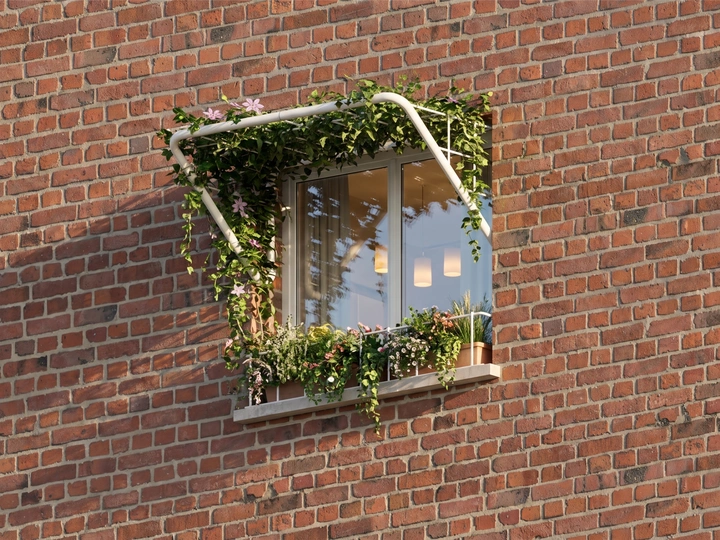
I propose a removable shading system for exposed south-facing windows: a lightweight steel trellis, cold-bent and unwelded, mechanically fixed to the window jambs, no major works, carrying a deciduous climber. In summer its foliage blocks high-angle sun; in winter, bare branches let light through. Wind-load estimation under Spanish building code confirms it is buildable.
Restoring that shade still requires consent — not the municipality's, but a building community's own. The design does not remove that requirement, it reduces its scope from a full façade intervention to a single window. That threshold is low enough for a tenant or owner to clear alone: replicable across the housing stock this city shares with Europe, before more of it reaches these summers.